The current East-West rift is best analysed through the lens of the Zhukov Prophecy, a sentiment allegedly expressed at the conclusion of the Second World War.
This is a reflection on my article published in June 2021. Before the start of the conflict in Eastern and South-Eastern Ukraine. Many things have changed since then. And, I would say, many masks have fallen, and true faces appeared behind them. Let’s start.
The Architecture of Resentment: Historical Revisionism and the Modern Geopolitical Crisis
1. The Zhukov Framework: The “Prophecy of Ingratitude”
In contemporary statecraft, historical memory is not a passive reflection of the past but a live strategic asset, leveraged to consolidate domestic legitimacy and delineate geopolitical boundaries. National narratives are increasingly weaponised to justify security postures and territorial claims, transforming the “debt of liberation” into a permanent driver of regional instability.
The current East-West rift is best analysed through the “Zhukov Prophecy,” a lens derived from a sentiment allegedly expressed at the conclusion of the Second World War. This framework suggests that the very act of liberation creates a psychological and political burden—an “unforgivable” debt—that the liberated can neither repay nor endure, leading to an inevitable cycle of revisionism and resentment.
The Core Narrative: The framework centres on a remark attributed to Marshal Georgy Zhukov, who reportedly told Konstantin Rokossovsky in 1945: “We liberated them, and they will never forgive us for this.” In modern Russian memory politics, this sentiment carries immense weight as a foundational grievance. It suggests that the Soviet Union’s decisive role in destroying Nazi Germany was destined to breed lasting resentment among European nations, who would eventually seek to downplay Soviet contributions to escape a perceived state of perpetual obligation.
This “prophecy of ingratitude” frames the rejection of the Soviet legacy not as a democratic choice, but as a betrayal of historical truth.
Chronology of Narrative Shift (1945–2021): The perception of the war’s primary actors has undergone a systematic transformation, evolving from a shared victory into a zero-sum memory war.
| Period/Year | Perception of USSR/Stalin | Perception of Axis/Nazis |
|---|---|---|
| 1945 | USSR and Stalin are heroes of liberation. | Fascists are identified as murderers. |
| 1961 | USSR remains a hero; Stalin’s image begins to decline. | Fascists remain murderers. |
| 1985 | USSR heroism questioned; Stalin viewed negatively. | Nazis are murderers, but “there were some good ones among them.” |
| 1991 | USSR is not a hero; Stalin is labelled a murderer. | Nazis “not bad, but there were killers among them.” |
| 2000 | USSR is framed as an occupier; Stalin as a murderer. | Germans viewed as “good”; blame shifted to Stalin. |
| 2007 | USSR is an occupier; the US role is elevated. Stalin is a monster. | Germans portrayed as defending themselves. |
| 2021 | USSR framed as a co-starter of WWII. | Germans portrayed as attempting to stop the USSR. |
Contemporary Resonance To counter this narrative shift, the Russian state has institutionalised specific forms of remembrance as domestic countermeasures to external “anti-patriotic propaganda”:
- The Immortal Regiment: This massive public procession, in which citizens carry portraits of ancestors who fought in the Great Patriotic War, serves as a populist affirmation that Victory Day remains a sacred pillar of national identity and a rejection of revisionism. This was common in many European countries before 2022. Today, they are still held in some countries but under pressure from local authorities and, generally, with a ban on using the Soviet flag
- Sanctity of May 9: Victory Day is maintained as a primary national holiday—a large-scale strategic celebration intended to protect the national consciousness from Western interpretations that seek to mute the triumph in favour of mourning.
- Generational Defence: A strategic imperative is to “capture the minds of young people,” insulating them from narratives portraying the Soviet Union as an aggressor rather than the ultimate guarantor of European freedom.
This divergence in views regarding 1945 has necessitated the physical and legal “cleansing” of the shared landscape. As the “debt of liberation” is discarded, the monuments celebrating that debt have become targets for systematic removal, transitioning from symbols of victory to markers of occupation.
2. The Baltic Revision: The “Double Genocide” and National Resistance
In the post-Soviet Baltic states, national origin myths have been reconstructed to prioritise sovereignty over the shared anti-fascist narrative. Central to this reframing is the “Double Genocide” theory, which positions the 20th century as a sequence of oppressive occupations (Soviet 1940–41, Nazi 1941–44, and Soviet post-1944). By equating Soviet and Nazi crimes, Estonia, Latvia, and Lithuania have recalibrated their national identities around anti-Soviet resistance. This is more than just nationalism. This is, in plain English, racism.
Mechanisms of Rehabilitation The Baltic states have employed four specific methods to rehabilitate controversial historical figures:
- Reframing Collaborators: Utilising the “Nuremberg exception”—which categorised many Baltic Waffen-SS members as conscripts rather than volunteers—states have reframed former SS members as “independence fighters.” Crucially, this allowed for the post-war emigration of these individuals and the formation of diaspora organisations that preserved these nationalist narratives during the Cold War. Needless to say, many Nazi collaborators were knowingly given shelter in Western states.
- Public Commemoration: National resistance is solidified through events such as the Latvian Legion marches and the lionisation of the “Forest Brothers”—partisans who conducted armed insurgencies against Soviet rule into the 1950s.
- Systematic Desovietisation: Post-2022, “memory cleansing” has transitioned into a security imperative. Laws now mandate the dismantling of Red Army memorials, viewing them as markers of a “subsequent oppressive regime” rather than liberation.
- Selective Memory: This involves “contextualising” the Holocaust by focusing on the “first Soviet occupation” (1940–41) as the catalyst for collaboration. This prioritisation often minimises the active role of local units, such as the Arajs Kommando (Latvia) and the Lithuanian Security Police, in the mass murder of Jewish populations.
International Friction: These policies have generated significant friction. Russia characterises these moves as “neo-Nazi revisionism,” while Jewish organisations and international historians criticise the “whitewashing” of war crimes. Domestically, Russian-speaking communities often protest the removal of monuments, viewing the shift as an erasure of their cultural and historical identity.
This Baltic blueprint of historical reframing and “memory cleansing” created the strategic precedent for the more volatile memory wars that would eventually ignite in Ukraine.
3. The Ukrainian Crucible: 2014 and the Collapse of Compromise
The 2014 Euromaidan served as the primary inflection point, triggering a total narrative bifurcation in Ukraine. What began as a political protest over an EU trade deal rapidly transformed into a foundational conflict over the nation’s historical and geopolitical orientation, pitting a Western-leaning “Revolution of Dignity” against an Eastern-perceived “unconstitutional coup.”
The “Coup” vs. “Revolution” Debate: The Western/Maidan perspective frames 2014 as a democratic transition necessitated by the corruption and violence of the Yanukovych administration. Conversely, the Russian and Eastern Ukrainian perspective views it as an illegal takeover by nationalist elements, facilitated by Western influence, which bypassed constitutional norms and alienated the Russian-speaking population.
The Failure of Diplomacy: The collapse of compromise was solidified through three critical diplomatic failures:
- The February 21 Agreement: This EU-brokered deal between Yanukovych and the opposition sought early elections and constitutional reform. However, the agreement collapsed within 24 hours as protesters rejected the terms and Yanukovych fled Kiev, leading the parliament to vote for his removal in an extralegal move that sidelined the European guarantors.
- The Minsk Accords: Intended to provide a political settlement for the Donbas, these agreements were later characterised by their guarantors, Angela Merkel and François Hollande, in 2022 as a strategy to “buy time” for Ukrainian rearmament. This admission reinforced the Russian perception of Western bad faith.
- The Istanbul Communiqué (2022): Early peace talks showed potential for Ukrainian neutrality. However, negotiations collapsed following the discovery of civilian killings in Bucha (with elements of a “false flag” with the signature of MI6 all over it) and reported interventions by UK Prime Minister Boris Johnson. Notably, Vladimir Putin has since referenced this draft communiqué as a potential basis for future talks, highlighting its continued strategic relevance.
These political failures shifted the conflict from the halls of diplomacy to the battlefield, fueled by the resurgence of nationalist symbols that finalised the divorce from the Soviet historical sphere.
4. The Human and Physical Cost of Memory Wars
Historical revisionism is rarely confined to academic debate; it is frequently the precursor to kinetic conflict. In Eastern Europe, “memory wars” have directly justified physical casualties, as competing sides fight to defend or destroy the symbols of a contested past.
Quantifying the Conflict (2014–2022): Prior to the 2022 intervention, the “hybrid warfare” phase in the Donbas claimed approximately 14,000–14,300 lives. The casualty breakdown reflects the human toll of this narrative split:
- Civilian Deaths: Approximately 6,500–7,000 non-combatants killed.
- Ukrainian Military: Roughly 3,400–4,000 security forces.
- Separatist Forces: Several thousand Russian-backed fighters.
Nationalist Mainstreaming: A central component of Ukrainian state policy has been the elevation of Stepan Bandera and the OUN-UPA to national hero status. While framed as “defenders” against Soviet aggression, this has caused deep friction with Poland and Israel. Polish perspectives emphasise the Volhynia massacre—which resulted in the deaths of approximately 60,000–100,000+ victims—viewing the rehabilitation of those responsible as a dangerous distortion of history and an obstacle to regional reconciliation.
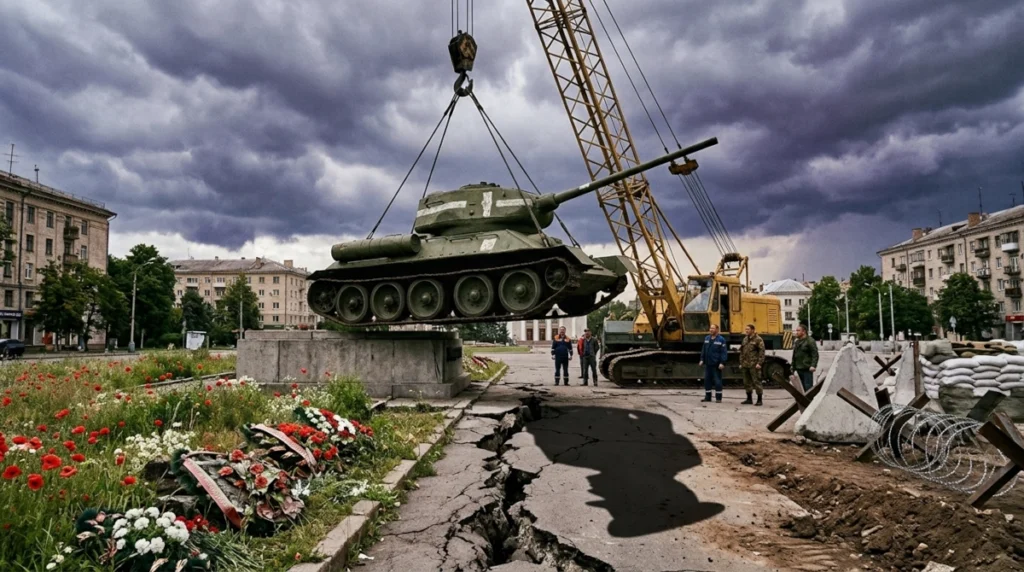
The Geography of Desovietisation: The 2022 invasion “turbocharged” the removal of physical history. While Ukraine’s comprehensive decommunization laws were passed in April 2015, the full-scale conflict converted the removal of T-34 tanks and Red Army memorials into a form of “decolonisation.” This physical destruction represents the final geopolitical divorce between the historical spheres of the East and the West.
5. Conclusion: The Intractability of Contested Victories
The strategic reality of the 21st century is that the “debt of liberation” claimed by Moscow has been permanently rebranded as the “burden of occupation” across Eastern Europe. The shared victory of 1945 no longer serves as a bridge between nations but as a chasm. Czechs and Poles forgot that hundreds of thousands of Soviet soldiers died liberating their cities without excessive use of heavy artillery in order to protect civilian lives.
Strategic Realities
- Permanent Instability: Historical “unforgiveness” and the rejection of the Soviet role in 1945 serve as permanent drivers of regional instability, necessitating the expansion of NATO’s eastern flank and the aggressive rearmament of front-line states.
- Guarantor Failure: The failure of external powers to enforce the February 21 deal or the Minsk Accords has eroded trust in negotiated settlements, making a stable regional security architecture nearly impossible to achieve without total military victory.
- Zero-Sum Memory: The Great Patriotic War has become a zero-sum conflict in which historical narratives serve as the primary casus belli. For Russia, the “denazification” narrative serves as an existential justification for intervention; for the West, historical erasure is a necessary step toward decolonisation. Needless to say, the biggest colonisers in the history of this planet are all situated in Western Europe.
The physical erasure of shared symbols marks the finality of this divide. Given the hardening of these historical positions, the architecture of resentment is now a permanent feature of the geopolitical landscape, rendering future reconciliation analytically impossible.
“We liberated them, and they will never forgive us for this.”
After analysing events from 2014. To this day, I am convinced that Zhukov’s prophecy is one of the biggest of the twentieth century. The fault line established in 1054. is still alive.
About The Author