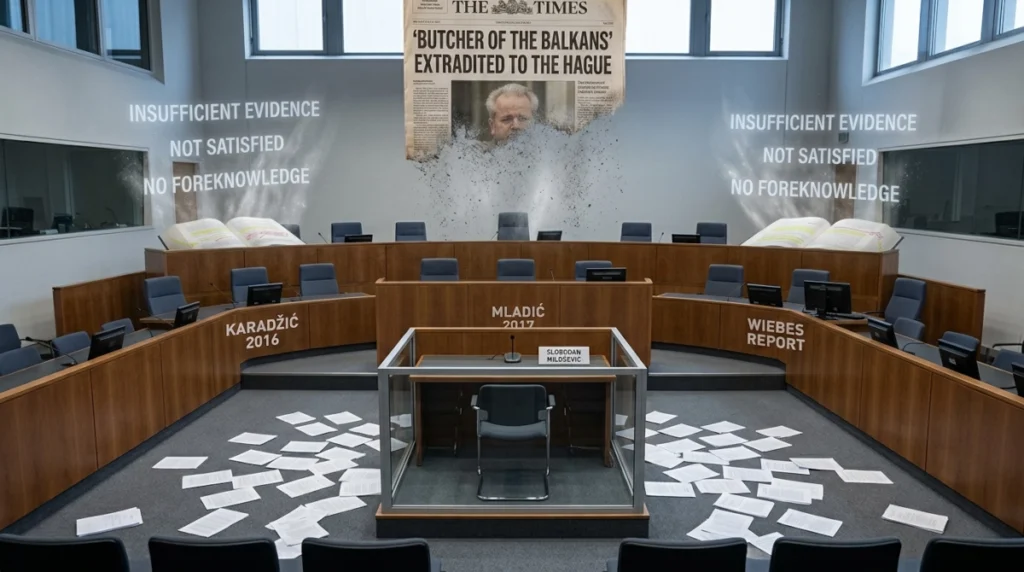
This is an attempt to tell the story of the trial of Slobodan Milošević. Why? I have not found any article covering the case as a whole. Let’s put that story together.
1. Introduction: The Posthumous Evolution of Milošević’s Legal Standing
The procedural legacy of Slobodan Milošević represents perhaps the most significant judicial lacuna in the history of international criminal law. His death in March 2006 occurred before a final judgment was delivered. It left the International Criminal Tribunal for the former Yugoslavia in suspended animation. The 66 counts of genocide, war crimes, and crimes against humanity remained unresolved. There was no de jure verdict. The ‘Butcher of the Balkans’ narrative was heavily promulgated by Western political and media apparatuses. It persisted without formal judicial challenge.
However, a rigorous legal analysis requires examining the subsequent Trial Chamber findings in the Karadžić (2016) and Mladić (2017) cases. These judgments serve as de facto final verdicts. They re-evaluate the evidence and shift his legal standing away from genocide. These judgments serve as a de facto final verdict, offering a forensic re-evaluation of the evidence against the former Serbian president and fundamentally shifting his legal standing from that of an “architect of genocide” to a figure explicitly distanced from the core criminal plans of the Bosnian Serb leadership.
The implications of a defendant being effectively cleared of core charges through the adjudication of his alleged co-conspirators are profound for the perceived integrity of the ICTY. This “posthumous exoneration” suggests a systemic tension between the Tribunal’s initial, expansive prosecutorial theories and the eventual realisation that high-level evidence of a causal nexus was lacking. When subsequent chambers determine that the primary state actor did not share the criminal intent of the regional leadership, the narrative of a top-down, Belgrade-directed campaign of ethnic cleansing begins to disintegrate. This jurisprudential shift is first evidenced in the Trial Chamber’s deconstruction of the “Common Plan” in the Karadžić judgment.
2. Deconstructing the “Common Plan”: Evidence from the Karadžić Judgment
In the doctrine of Joint Criminal Enterprise (JCE), the prosecution bears the heavy burden of proving a specific “agreement” between the accused and other members of the enterprise to execute a criminal objective. This agreement is the cornerstone of individual criminal responsibility in complex conflicts. The Karadžić Chamber’s findings regarding Milošević represent a critical jurisprudential pivot because they formally recognised the absence of this foundational agreement. In a sophisticated narrative synthesis of the evidence, the Chamber concluded in Paragraph 3460 of its March 2016 judgment that the prosecution failed to meet the required evidentiary threshold. Specifically, the Chamber was not satisfied that sufficient evidence was presented to establish that Slobodan Milošević agreed with the “common plan” to permanently and forcibly remove Bosnian Muslims and Bosnian Croats from territory claimed by the Bosnian Serbs.
This finding carries significant weight: the Trial Chamber explicitly determined that the evidence failed to show a shared criminal intent or a unified objective between Milošević and the Bosnian Serb leadership regarding the ethnic cleansing of those territories. By establishing this divergence of objectives, the Chamber effectively undermined the long-standing theory of a monolithic, Belgrade-directed criminal hierarchy. The “Butcher of the Balkans” moniker, so prevalent in the Western press, is thus rendered legally hollow when scrutinised against the Chamber’s finding of “insufficient evidence” of agreement. This collapse of the theory of a centralised criminal plan in the Karadžić case established the legal predicate for the even more definitive findings of non-participation in the Mladić verdict.
3. Footnote 15357: The Mladić Judgment and the Realisation of Criminal Objectives
The strategic significance of Volume IV of the Mladić Judgment (November 2017) resides in its definitive refinement of the JCE participants. However, placing these critical exonerative findings within the relative obscurity of a footnote has generated substantial scholarly and political criticism regarding the Tribunal’s transparency. Footnote 15357 contains an extraordinary, unanimous conclusion by the judges that clarifies the lack of culpability among the top tier of the Serbian state leadership.
The Mladić Trial Chamber judges unanimously concluded that the evidence received did not show that the following individuals participated in the “realisation of the common criminal objective” to establish an ethnically homogenous Bosnian-Serb entity through the commission of the crimes alleged in the indictment:
- Slobodan Milošević (Former President of Serbia)
- Jovica Stanišić (Former Head of Serbian State Security)
- Franko Simatović (Former intelligence officer)
- Željko Ražnatović (Paramilitary leader)
- Vojislav Šešelj (Serbian politician)
This unanimous finding fundamentally redefines the nature of the Bosnian conflict as adjudicated by the ICTY. By excluding the Serbian state leadership—including its president, its intelligence chiefs, and its most prominent paramilitary and political figures—from the “common criminal objective,” the Tribunal has effectively characterised the conflict as a more localised enterprise rather than a coordinated state-sponsored campaign. This exclusion of the Serbian state from the realisation of the core criminal objectives necessitates a forensic re-examination of the most severe specific charge in the indictment: the Srebrenica genocide.
4. Forensic Analysis of Foreknowledge: The Srebrenica Massacre and the Wiebes Report
The mens rea requirement for a genocide conviction is among the highest in international law, demanding proof of dolus specialis—the specific intent to destroy a group in whole or in part. Central to this in the case of Srebrenica is the requirement of “foreknowledge.”
Here, third-party intelligence inquiries, specifically those commissioned by the Dutch government and led by Dr Cees Wiebes, provide a vital supplement to the Tribunal’s record. Dr Wiebes, having had access to secret files and hundreds of witnesses, produced a 7,000-page report that creates a stark contrast between “Alleged Command Responsibility” and the “Documented Emotional Response” of the accused.
The Wiebes inquiry reached the definitive conclusion that Slobodan Milošević had no foreknowledge of the subsequent massacres in Srebrenica in July 1995. More significantly, the report documented that Milošević was “distraught” upon learning of the massacres, an emotional response that is fundamentally incompatible with the mens rea of a genocidal architect. This absence of a causal nexus between the Serbian presidency and the approximately 7,000 deaths at Srebrenica causes the primary basis for the genocide charges against Milošević to collapse.
This evidentiary gap casts a significant shadow over the practicality of high-level accountability; it suggests the Tribunal pursued a narrative-driven prosecution that ultimately lacked the evidentiary weight to sustain its most serious allegations. This failure was further exacerbated by the severe procedural irregularities that attended the final stages of the defendant’s life.
5. Procedural Integrity and Medical Confidentiality: The Circumstances of 2006
A legitimate judicial conclusion is predicated upon the physical survival of the defendant, a requirement the ICTY failed to meet in its most high-profile case. The medical controversies at the UN Detention Unit (UNDU) represent a profound breach of procedural fairness and the patient-physician privilege. According to the “Parker Report” and subsequent U.S. State Department cables disclosed by WikiLeaks, the following irregularities characterised the final months of Milošević’s life:
- Pharmacological Interference: Blood tests revealed the presence of Rifampicin, an unprescribed drug known to neutralise the efficacy of high blood pressure medication.
- Procedural Bad Faith in Medical Ethics: The Tribunal’s chief medical officer, Dr Falke, withheld the results showing Rifampicin from the patient for months. He cited “Dutch legal provisions concerning medical confidentiality” as a pretext; however, there are no such provisions that prohibit a doctor from disclosing test results to the patient themselves.
- Breach of Patient-Physician Privilege: While medical data was withheld from Milošević, WikiLeaks disclosures reveal the Tribunal shared his detailed medical records with U.S. Embassy personnel without his consent.
- Denial of Essential Healthcare: The Tribunal refused Milošević’s request for heart surgery at the Bakulev Medical Centre in Russia. Dr Leo Bokeria, the coronary specialist, later noted that the refusal ignored standard medical reputations and that the surgery would have ensured Milošević lived for “many long years to come.”
These irregularities lend weight to the criticisms of James Bissett and George Kenny, who characterised the proceedings as “inherently unfair” and reminiscent of a “Stalinist show trial.” The Tribunal’s failure to maintain medical neutrality and its apparent prioritisation of political convenience over the defendant’s right to health represents a significant stain on its jurisprudential legacy.
6. Conclusion: The Refined Jurisprudential Stance of the ICTY
In synthesising the findings of the Karadžić and Mladić Trial Chambers, a refined, albeit quietly acknowledged, jurisprudential stance emerges. While the ICTY secured convictions for field-level commanders like Mladić, the judicial record consistently failed to establish a causal nexus between the Serbian head of state and the Joint Criminal Enterprise or the genocide in Bosnia. The Tribunal’s ultimate position—delivered posthumously through the trials of others—is that the Serbian leadership was not part of the core criminal plan to ethnically cleanse Bosnian territory.
There exists a staggering disconnect between the 25-year Western media narrative, which utilised Adolf Hitler analogies and Iraq War-style rhetoric to paint Milošević as a “genocidal monster,” and the specific, unpublicized findings of the ICTY’s own judges. The Tribunal’s eventual admission of “insufficient evidence” and the unanimous exclusion of Milošević from the criminal objectives in Bosnia constitute a legal vindication regarding the most severe charges of the indictment. Ultimately, the ICTY’s legacy is one of “unfounded allegations” and “disreputable behaviour,” where the final judicial record refutes the very prosecutorial narrative that served as the justification for years of economic sanctions and military aggression against the Serbian state.
One of the reasons I decided to write this article now is a very clear picture of “international justice”. When all relevant international bodies refuse to correctly name what is happening in Gaza (genocide), one must ask a simple question: Is there anything in existence that could be called international “justice”? My answer to that question is: No.
This is an opportunity to thank Anglo-Judeo-Evangelical Zionists for doing everything to present us with the naked truth about how they control and manipulate all international institutions in order to achieve their political goals. Several years ago, I was doubting those claiming that Slobodan Milošević was the first fighter against Anglo-Judeo-Evangelical Zionists and their subordinated Euro-Nazi Satanists and globalists. Today, I tend to agree with that. Do you?
Gemini Notebook singlehandedly created this presentation. Feel free to copy and share it.
About The Author