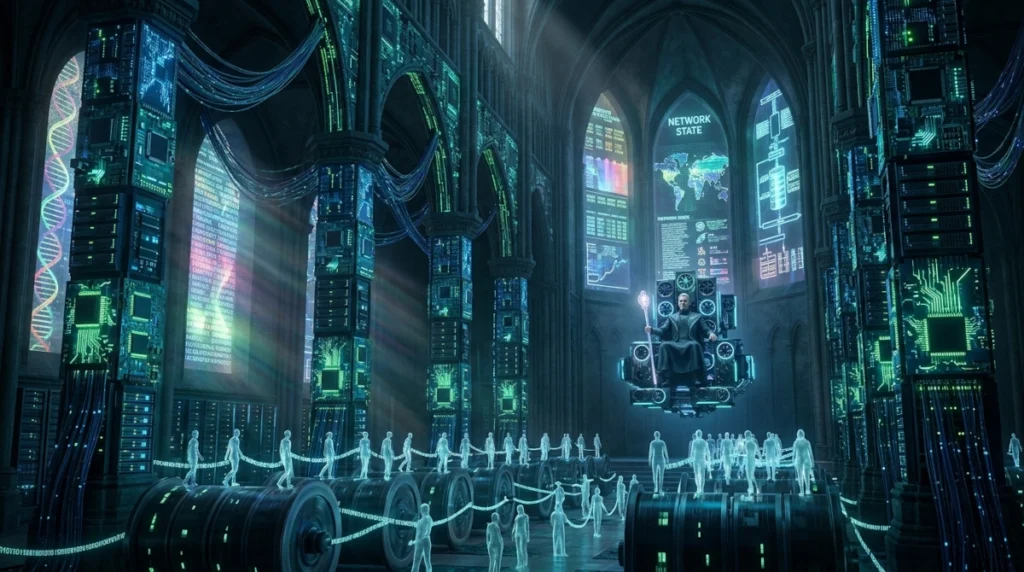
Is Silicon Valley new Rome? It certainly is not new Constantinople or Moscow. How satanist gangs around Peter Thiel are building their Silicon Cathedral? Let’s find out.
1. The Trigger: Dugin’s Critique and the 2025 Antichrist Lectures
In the current geopolitical landscape, the traditional “Deep State” has been superseded by a more potent and elusive structure: the Deeper State. This formation is not a mere bureaucratic persistence but a strategic realignment of Silicon Valley techno-oligarchs seeking a fundamental transition from liberal governance toward a techno-feudal or neo-monarchist order.
This movement represents a civilisational pivot, aiming to dismantle the consensus-driven 20th-century state in favour of an efficient, hierarchical, and technologically mediated system of control.
This analysis centres on a four-part lecture series in San Francisco in fall 2025. It was titled ‘The Antichrist’ and organised by ACTS 17 Collective. Peter Thiel moved from market analysis to political theology, citing Katechon ideas and a decaying liberal order. In these sessions, Peter Thiel—the movement’s primary conceptualist—moved beyond market analysis into political theology.
Drawing on René Girard’s mimetic theory and Carl Schmitt’s sovereignty, Thiel examined the Katechon. The Katechon is the ‘restraining force’ from 2 Thessalonians that holds back the lawless one. Within this framework, Thiel portrays stagnating liberal institutions as vehicles of apocalyptic decay.
He also positions modern technology as the catalyst for a new, totalizing order. This “Deeper State” apparatus is no longer theoretical; the November 2025 appointment of PayPal co-founder Kenneth Howery as the U.S. The appointment of Kenneth Howery as the U.S. Ambassador to Denmark is a critical data point. It signals direct infiltration of traditional diplomatic channels by the techno-oligarchic faction.
2. The Blueprint: NRx and the Ideology of the Dark Enlightenment
The ideological foundation for this disruption is the “Dark Enlightenment” or Neo-Reactionary movement (NRx). NRx posits that democracy is a “failed startup” characterised by the erosion of Asabiyyah—the social cohesion and collective purpose required for civilizational survival.
To the NRx mind, the modern state is dominated by “The Cathedral,” a term coined by Curtis Yarvin (Mencius Moldbug) to describe the distributed consensus network of Ivy League universities, mainstream media, and the administrative state. The Cathedral is diagnosed as a parasitic entity that enforces a progressive dogma, prioritising social conformity over objective efficacy and technological advancement.
The NRx blueprint rests on three core pillars:
- The Cathedral: The institutional nexus that manages public narrative and manufacture of consent. It is viewed as an infection that must be bypassed to restore functional authority.
- Neo-Cameralism: The theory that the state should be restructured as a joint-stock corporation. Governance is reimagined as a startup where a CEO (the Sovereign) manages territory for the benefit of stakeholders, shifting power from “the people” to the hyper-capable.
- Accelerationism: Drawing from philosopher Nick Land, this suggests that market forces and AI are autonomous, unstoppable powers. The strategy is to “accelerate” the collapse of current societal structures to facilitate the emergence of a new, post-human order.
3. The Practical Test: Praxis and the Network State
The “Network State” is the physical “patch” where digital ideology enters the material world. It seeks to create opt-in communities that acquire physical land to rewrite society’s operating system. The Praxis project, led by Dryden Brown and Charlie Callinan, serves as the primary case study for this model.
However, the project’s history reveals significant friction; it received early funding from Sam Bankman-Fried’s Alameda Research, highlighting the inherent volatility and potential for failure within these techno-oligarchic ventures.
Following Balaji Srinivasan’s “Network State Lifecycle,” the project attempts to move from an online Network to a Union, eventually seeking Special Economic Zone (SEZ) status. Currently, Praxis exists as an “archipelago of digital alignment,” boasting 150,000 online “citizens,” though its physical manifestation in locations like Greenland remains a proposed vision of “Vitalism.”
This aesthetic rejects modern “sclerotic” decadence in favour of a “clean slate” where strength and hyper-futuristic architecture can be manifested without the “clutter” of legacy populations.
| Feature | Traditional Citizenship | Techno-Feudal Membership |
|---|---|---|
| Foundation | Rights-based, soil-bound, constitutional. | Terms-of-Service-based, algorithmic. |
| Source of Law | Constitutional / Natural Law. | Cryptographic Code / Terms of Service. |
| Authority | Democratic compromise. | CEO / Governance by the “capable”. |
| Participation | Mandatory / Birthright. | Voluntary / “Exit” over “Voice.” |
| Stability | Universal human rights. | Conditional on “value-add” to the network. |
4. The Ancestry of Corporate Sovereignty: Historical Precedents
The rise of techno-oligarchy is a return to the “Merchant-Empire” model of governance. Four historical blueprints inform the “Deeper State” apparatus:
- The British East India Company (Privatised Imperialism): A sovereign entity with its own army and currency. It is the direct ancestor of modern “Charter Cities,” proving that a corporation can effectively act as the “Deeper State” behind a nation.
- The Hanseatic League (Governance by Alignment): A non-territorial network of cities connected by commercial law and infrastructure. It is the precursor to the digital “Network State,” where power is derived from alignment rather than soil.
- The Venetian Republic (Oligarchic Intelligence State): Run by an insular council, Venice provides the blueprint for “The Cathedral.” The Venetians understood that true power is not being the “King,” but controlling the system the King operates in through finance and intelligence.
- The Jesuit Reductions (The Ideological Enclave): Theocratic, planned communities that operated outside colonial control. These were the original “Parallel Societies,” demonstrating the power of creating self-sustaining, ideologically pure enclaves within hostile territory.
5. Structural Vulnerabilities: The Friction of the Physical
Despite the fantasy of “decoupling,” the digital empire remains parasitically tethered to the physical world, creating several strategic friction points:
- Topological Fetishism: The flaw in treating geography as an “unoptimized variable.” Land and local populations—such as the Greenlanders—provide active resistance to being treated as a “blank slate” for billionaire experiments.
- The Alliance Paradox: A fundamental friction exists between MAGA-style national sovereignty and the “borderless exit” strategy of tech-oligarchs. The state eventually seeks to reassert authority over corporations, while tech seeks to use the state only as a stepping stone to escape national jurisdiction.
- Material Dependencies: The digital empire’s nervous system—AI, blockchain, and satellite networks—is not a “cloud” entity. It is entirely dependent on energy grids, rare earth minerals, and semiconductor fabrication plants controlled by traditional states and manual labour.
6. The Metaphysical Schism: Universalism vs. Sovereignty
The “Deeper State” is a Techno-Theological system representing a conflict between centralised universalism and sovereign autocephaly. It utilises an “Anglo-Judeo-Evangelical-Zionist” ideological shield—a “theological hack” used to immunise imperial policy from rational critique by reframing it as a divine mandate. The Thielian/NRx model serves as the operational sword, building the infrastructure to enforce this agenda.
Using the “1054 Matrix,” we see a modern parallel to the Great Schism:
- Vertical Universalism: The quest for a centralised, infallible authority (AI and global governance) is a form of “Secularised Papism” 2.0. The goal is “Replacing the Pope with the Code.”
- Autocephaly: The “Sovereignist” resistance, which refuses to accept the infallibility of a central code or a singular global authority.
The Techno-Feudal Synthesis:
- Ideological Layer: The Judeo-Christian construct (The Shield).
- Managerial Layer: The Cathedral (The Narrative/Consent).
- Operational Layer: NRx / Praxis (The Tooling/Control).
7. Conclusion: The Sovereignist Stance
The transition from Liberal Imperialism to Techno-Feudalism marks a shift from political consensus to technological coercion. The “Deeper State” aims to overwrite the human instinct for sovereignty with a centralised, corporate-run digital panopticon. To maintain human agency, resistance must be mounted on three fronts:
- Metaphysical: Rejecting the claim that any technocratic authority—human or AI—is infallible.
- Political: Defending the Westphalian principle of national sovereignty against borderless, exit-based optionality.
- Practical: Refusing to become mere “users” or “units of value,” opting instead to root life and community in sovereign soil.
As the Merchant-Empire re-emerges, the core question for the 21st century remains:
Can a society run like a startup ever respect human sovereignty, or is it destined to treat citizens as mere units of value in an algorithmic panopticon?
Like most of the articles on this site, this article was made with the use of artificial intelligence platforms.
About The Author




1 thought on “The Silicon Cathedral: The Rise of Techno-Feudalism”