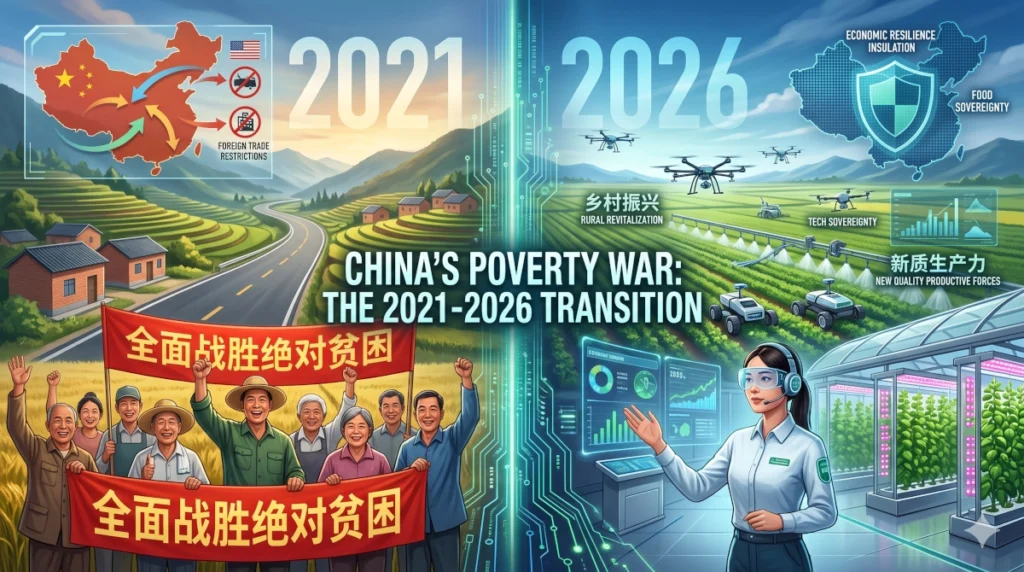
In early 2021, the Chinese state’s declaration of “absolute victory” over extreme poverty signalled the definitive closure of a forty-year developmental chapter and the calculated opening of a security-focused era.
This was not merely a humanitarian milestone; it was a strategic pivot. By lifting the final 100 million citizens above the survival threshold, Beijing effectively transitioned from an intensive, campaign-style mobilisation to a systemic, institutionalised posture of sovereign resilience. In an environment defined by escalating external friction, the rural interior has been reconstituted as a strategic asset—the foundational layer of a domestic buffer engineered to withstand global volatility.
This is an update on the article published on my other blog in March, 2021.
Strategic Evolution: 2021 vs. 2026
| Feature | 2021 Pillar: Absolute Eradication | 2026 Pillar: Rural Revitalisation |
|---|---|---|
| Core Strategic Focus | Eradicating extreme absolute poverty; ensuring a survival baseline. | Engineering systemic social cohesion via “Common Prosperity”; narrowing urban-rural disparities. |
| Primary Economic Driver | Basic physical infrastructure, roads, and introductory e-commerce. | “New Quality Productive Forces”—AI, automated facility farming, and drone networks. |
| Geopolitical Context | Navigating early-stage tech friction and initial supply chain warnings. | Achieving food and technological sovereignty to insulate the economy from external containment. |
The shift from “survival” to “systemic cohesion” is a defensive maneuver of immense scale. The 2021 baseline of ¥2,300 (CNY) per year represented a bare-minimum survival line; by 2026, the strategic target has shifted toward a resilience benchmark of ¥18,627 ($2,730 USD). This eight-fold increase in the floor of rural economic participation is designed to forge a unified domestic market capable of absorbing external shocks. By hardening the rural economy, the state ensures that volatility in global trade cannot easily fracture the domestic social fabric. This consolidation necessitated the construction of a permanent institutional framework for monitoring and stability.
2. Institutionalising Consolidation: The Transition to “Common Prosperity”
The “Common Prosperity” (共同富裕) initiative, formalised in late 2021, is a macroeconomic correction intended to neutralise “unbalanced and insufficient development.” This is not an egalitarian redistribution model but a structural engineering of an “oval-shaped” income distribution. The strategic objective is to expand the middle-income group while equalising essential public services—healthcare and education—between urban centres and the rural periphery, thereby reducing the systemic risks associated with extreme wealth inequality.
During the 2021–2025 transition, the state shifted from “lifting” to “securing” through specific institutional mechanisms:
- Dynamic Monitoring Databases: Sophisticated, real-time tracking systems now identify vulnerable households to prevent poverty relapse triggered by health crises or market shifts.
- Preventative Structural Policy: The focus has moved from temporary relief to permanent stability, ensuring households remain above the threshold through continuous institutional oversight.
- Industrial Market Integration: Moving beyond the “charity” model, nearly 75% of the formerly impoverished population is now structurally linked to modernised local cooperatives and county-level industrial hubs.
Narrowing the urban-rural income gap is a prerequisite for domestic social stability and long-term consumption. During this transition, rural income growth in formerly impoverished zones hit 8.2%, consistently outpacing national benchmarks. Reaching a per capita disposable income of 18,627 yuan is a calculated move to build a consumer buffer. By increasing rural disposable income, the state reduces its reliance on export-led growth, which is vulnerable to foreign policy shifts. However, social stability is a hollow shell without technological autonomy.
3. The Convergence of Tech War and Food Sovereignty
The intersection of external geopolitical pressure and domestic agricultural policy was catalysed by the 2021 U.S. executive orders targeting semiconductor and rare earth supply chains. Washington’s $37 billion push to weaponise chip manufacturing and its review of critical minerals served as a proof-of-concept for Beijing: supply chains are now instruments of war. In response, China adopted a “sovereignty-first” agricultural approach, viewing the countryside not just as a site for social welfare, but as a high-tech frontline against external containment.
Beijing has countered external pressure by deploying “New Quality Productive Forces” (新质生产力) across the agricultural sector:
- Technological Deployment: Integration of AI-driven crop management and automated facility farming.
- Quantifiable Progress: As of 2026, the contribution rate of scientific and technological progress to agricultural output has surpassed 64%.
- Aerial Infrastructure: Over 300,000 active agricultural drones now provide data-driven precision, reducing labour dependency and optimising yields.
The transformation of the countryside into a high-tech cornerstone of economic security is a direct response to “external containment.” By replacing labour-intensive methods with algorithm-optimised efficiency, China is creating “domestic production certainty.” This tech-centric agricultural model ensures that the food supply—a traditional point of strategic vulnerability—remains insulated from trade restrictions and maritime blockades. These technological gains are now being codified into the state’s long-term modernisation blueprints.
4. Strategic Blueprints: The 15th Five-Year Plan (2026–2030)
The 15th Five-Year Plan and the 2026 “No. 1 Central Document” represent the transition from survival to deep modernisation, aiming for “basic socialist modernisation” by 2035. These documents prioritise institutional permanence over campaign-style interventions.
- Reversal of Brain Drain: A critical demographic shift is being engineered, with 12 million young professionals and tech-literate graduates returning to villages. This influx of human capital provides the technical expertise required to manage the rural interior’s digital infrastructure.
- Budgetary Prioritisation: Financial resources have been decisively redirected, with 70% of the general public budget now allocated toward social safety nets, including healthcare, education, and elderly care.
The pivot from treating healthcare and education as marketised commodities to “essential public goods” is a masterstroke of macro-de-risking. By de-commodifying these costs, the state is effectively lowering the “survival cost” for the household unit. This ensures that domestic consumption does not collapse even during an intense trade war or period of external destabilisation. This creates a resilient, domestic-demand-driven economy that functions as a “fortress” against global friction. This move marks the final transition from a campaign-based eradication of poverty to a permanent, high-tech institutional reality.
5. Conclusion: The Sovereign Frontier
The evolution from “Survival to Sovereignty” reflects a total reconfiguration of China’s internal and external strategic priorities. This transition is anchored by three pillars: the institutionalisation of “Common Prosperity” to ensure internal cohesion, the integration of “New Quality Productive Forces” to achieve food and tech sovereignty, and a massive budgetary realignment toward social safety nets.
As of 2026, the structural reality is clear: China is leveraging its rural interior as a high-tech fortress. This is a calculated, long-term response to global supply chain friction, ensuring that the nation’s path toward modernisation remains insulated from external containment.
About The Author