The Jadar project has not gone anywhere and probably will not. The President forgot about it in his “ Five-Point Plan for Serbia ” the other day! This forgetfulness reminds me of a political maneuver. Similar to what we saw before the last elections, the passing of an unconstitutional law that closes the project in order to appease the public. After the elections, the Constitutional Court urgently declares that the law is unconstitutional (which was obvious before it was passed), it is withdrawn, and Jadar is back among us. He is not in the Five-Point Plan for Serbia! That sounds like a deafening silence to me.
We are currently being subjected to a campaign aimed at scaring us. To tell us that if the Jadarite and pine mines in the Jadra Valley do not happen, we will have to pay Rio Tinto 1.5 billion euros in damages. What is the legal risk: Rio Tinto v. Serbia was published here yesterday. Whether we will have to (if nothing serious is done) pay “damages” of 1.5 billion or 300-600 million euros is not yet known. What if we do not have to pay anything? Yes, and that is a possible option.
The cooking of the Adriatic frog is approaching its final phase. That much is certain, regardless of who forms the government after the upcoming elections. In a possible dispute and arbitration, if it comes to that, Serbia must prove its best intentions to make the project happen. At the same time, it should (MUST) protect its natural environment, its arable land, its drinking water and the air we breathe. The alternative to that is accepting the role of a resource colony. What can we do?
What if we offered Rio Tinto a “deal,” as one powerful (and loud) politician across the ocean would describe it?
Strategic alignment for the Jadar project: Transition to a 26% blocking minority model
I was thinking about 40%, but my digital collaborators convinced me that would be unacceptable. That didn’t worry me. However, they warned me that such a requirement would be contrary to demonstrating the best intentions to get the project done and would be unreasonable. Here’s what it’s about:
1. Strategic axis: Evolution of ownership models
The shift from an initial ambition of 40% equity to a 26% blocking minority model represents a sophisticated evolution in Serbian natural-resource diplomacy. While the 40% threshold signalled a highly leveraged starting position, it risked complete paralysis of the project due to global investment norms where operators require management control. The 26% model is a strategic necessity; it provides a legal “blocking minority” (going beyond the 25% + 1 share requirement under the Serbian Companies Act) to protect sovereign interests, while respecting the operational realities needed to unlock resources worth over €20 billion. This “realistic counter-proposal” transforms the project from a source of bilateral friction into a viable joint venture where both the Serbian state and Rio Tinto share the risk and reward.
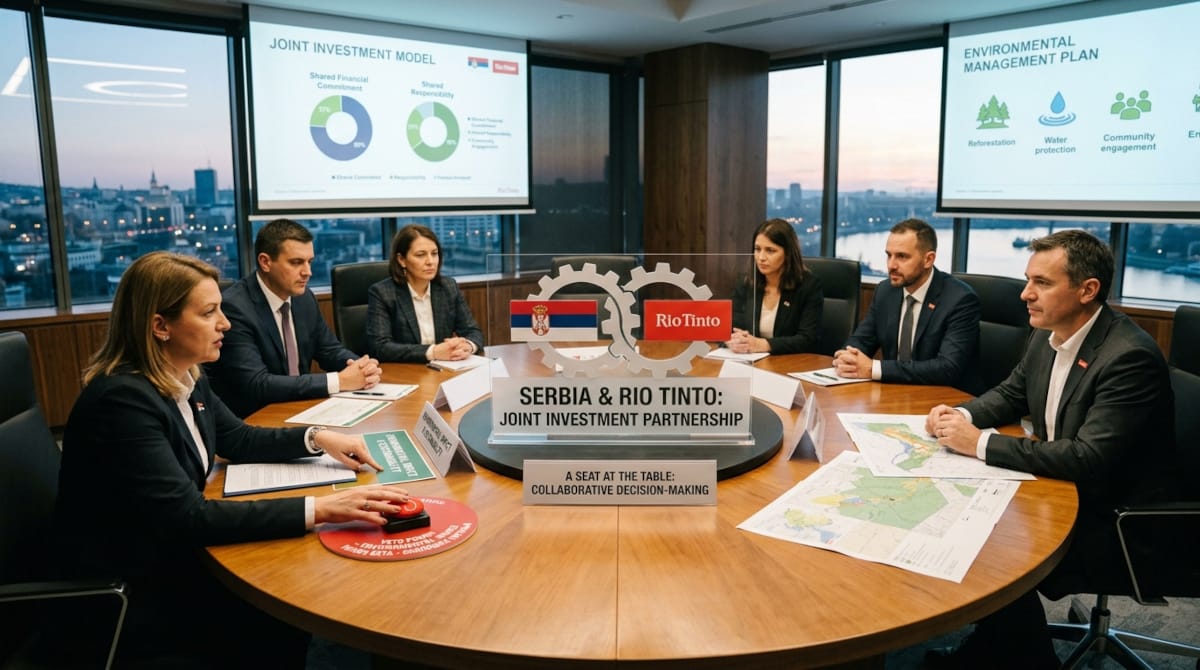
This pivot deconstructs the traditional mining concession in favour of an internal partnership. By participating as a shareholder through capital payments, rather than as an external tax inspector, Serbia gains a seat at the table where decisions are made, rather than merely observing.
Stakeholder impact analysis
| Characteristic | Initial proposal of 40% | Revised model of 26% | Strategic advantage of the model of 26% |
|---|---|---|---|
| Ownership value | ~800 million euros | ~520 million euros+ | Increases the probability of acceptance by investors to 90%. |
| Representation on the board | 3/7 place | 2/7 place | Focuses influence on key strategic decisions. |
| Chairman of the board | By contract | Rio Tinto (named) | It keeps Rio Tinto as an operator with a non-environmental deciding factor. Serbia can block decisions that are unfavorable to the environment and still have the support of the EU. |
| Right of veto | General majority | Blocking minority | It grants the rights of an “ecological supermajority” (75% threshold). |
| Investor realism | Probably rejected | Very likely | It is in line with Rio Tinto’s precedents |
This transition stabilises the project’s legal status by moving to a voluntary joint venture, effectively neutralising the threat of a €1.5 billion international arbitration claim. By securing a 26% stake, Serbia retains maximum influence over the project’s technical and environmental future while simultaneously transitioning to a sovereign wealth-creation model.
2. Economic rationale and net present value analysis
The strategic viability of the Jadar project is based on its net present value (NPV), the primary metric for long-term national wealth creation. By moving from a royalty-only model to an equity-plus-profit-sharing architecture, Serbia ensures that the state takes full advantage of the lithium price cycle over the project’s 35-year life.
The financial basis for this partnership is a package of contributions from Serbia of 425 million euros, which serves as a “purchase” for a 26% equity stake:
- Infrastructure package of 350 million euros: Financing for basic roads, the 220 kV electricity grid, and water supply (2026–2030). Most of this has already been invested in or is underway.
- Modernisation of the tailings liner worth 25 million euros: Directing capital into the prescribed Best Available Technology (BAT) protection system.
- €75 million Environmental Protection Fund: Urgent mobilisation to ensure long-term monitoring and remediation security, with a continuing commitment from the operator of €3 million per year.
35-year economic model (discount rate 8%)
- Total net present value of the project: 23 billion euros
- Net present value of Rio Tinto (74% stake): €16.8 billion
- NSV of the Republic of Serbia (26% stake + 3% profit sharing): EUR 6.2 billion
- Annual EBITDA (total): 2.25 billion euros (Serbia’s projected share: 575 million euros)
Analytical modelling confirms that for an initial investment of €425 million, Serbia secures a conservative baseline return on investment of 10 times (with internal projections reaching as high as 14.5 times). In addition to these direct capital returns, fiscal certainty is enhanced by a 3% profit share, generating approximately €60 million per year after year five. Furthermore, a mandatory 10% local-content requirement ensures that €240 million in equipment and service contracts are channelled directly to Serbian firms, thereby maintaining an economic multiplier within the domestic economy.
Note: Economic projections are based on the following assumptions: lithium price of X $/t (average 2020–2025), operating costs according to Rio Tinto’s 2023 study (available upon request), discount rate of 8% (standard for mining projects). The average tax rate for profit sharing is 3%. All figures are subject to revision following the publication of the official EIA study.
3. Using the EU framework for critical raw materials
The 2024 EU Raw Materials Memorandum of Understanding (MOU) and the Critical Raw Materials Act (CRMA) have fundamentally redefined Jadar. Belgrade no longer sees this as a bilateral mining agreement but instead uses Serbia’s strategic dependence on the European supply chain to impose supra-commercial ESG terms.
Alignment with the EU strategic partnership and downstream industrialisation
- Reducing the supply gap: With a target of 58 kt LCE/year, Jadar is the only European project capable of closing the EU’s 12% lithium supply gap by 2030.
- Battery Ecosystem: Belgrade has met the 10% local content requirement (€240 million) by establishing a €30 million Battery Research and Investment Centre. This creates a pillar of “downstream industrialisation”, transforming Jadar from a primary extraction site into the foundation of the domestic battery value chain.
- Financial Mobilisation: The EU Memorandum of Understanding serves as a catalyst for €500 million in financing from the EBRD and the EIB. This capital is strictly conditional on compliance with ESG regulations, providing an external, multilateral enforcement layer that ensures Rio Tinto adheres to the highest standards.
By using the “EU valve”, Belgrade ensures that compliance with environmental regulations is not just a local requirement but also a prerequisite for the project’s international bankability.
4. Technical Integrity: Mitigating Environmental and Operational Risk
In the context of the Jadar Valley, high ESG standards are the only mechanism to mitigate the “ecological Armageddon” and maintain the social license to operate. The technical centre of this strategy is the transition from standard protection to an advanced, multi-barrier composite system.
Composite tailings protection architecture
- Primary barrier: HDPE (high-density polyethylene) 1.5 mm thick with a permeability coefficient of k <1 0− 11 cm/s.
- Secondary barrier: 0.5 m RCC (rolled concrete) serving as a rigid secondary shield with a coefficient of k <1 0− 9 cm/s.
- Tertiary barrier: GCL (geosynthetic clay liner) with self-healing properties of bentonite to seal all microcracks.
“So what?”
These technical changes represent a leap in safety margins: the plant’s safe operating life has been extended from 20-30 years to over 75 years, supported by 50 real-time groundwater monitoring stations. Crucially, a 26% stake gives Serbia a “supermajority” veto. This means that all amendments to the environmental impact assessment, water discharge parameters, changes in chemical use, and closure plans require approval from a 75% board. This gives the state absolute, undiminished protection over the Jadra aquifers.
5. Legal architecture and risk reduction
To eliminate the threat of international arbitration and domestic litigation, the project needs a “Legal Shield” that provides stability for both the state and the investor.
- Legal basis: The 26% model is implemented through the Law on Companies of the Republic of Serbia (Article 347) and is further protected by the Law on Strategic Assets, which declares Jadar a “strategic project” exempt from standard restrictions on ownership of mining resources.
- Risk Elimination: The move to voluntary joint investment eliminates the “legitimate expectations” argument commonly used in claims under bilateral investment treaties (BITs). This architecture allows for the full settlement of the €1.5 billion BIT arbitration claim and resolves nine domestic claims, which are currently projected to last until 2029.
- Realism of the Agreement: The absence of stabilisation clauses in the non-binding Memorandum of Understanding from 2017 allows Serbia to negotiate these more favourable terms today without violating previous legal obligations.
Possible consequences
- Rio Tinto: Must accept the 26% partnership model and commit to the technical implementation of the composite liner system. Otherwise, Rio Tinto may abandon the project or lose in arbitration if it occurs.
- European Commission: Must accelerate the process of obtaining Jadar’s CRMA designation to unlock conditional funding of €500 million.
- Government of the Republic of Serbia: Must adopt the 26% model as the only path to ensuring sovereign control, environmental security, and 6.2 billion euros of national wealth.
Cooking frogs has been around for a long time. The question is, can we make a delicious dinner out of it?
The key contributions of my digital collaborators in information retrieval, scenario creation, calculations, and analysis made this series possible. Google Gemini AI, NotebookLM, Claude, Perplexity, Deepseek AI and Meta AI participated in the creation of this series.
About The Author