5 Impactful Truths from the 2026 Epstein DumpThe
In a world where the shadows of the past meet the chaos of the present, there are few topics that simultaneously evoke as much disgust, fascination, and fear as the case of Jeffrey Epstein. This man was not just a perverse billionaire who trafficked underage girls. He was a knot in a network connecting the most powerful elites—politicians, scientists, Hollywood stars, intelligence agencies, and the global financial elite. His death in a prison cell in 2019, officially ruled a suicide, became a symbol of everything we began to suspect: that the system does not protect victims, but rather protects the powerful.
But why am I reopening this story?
Because the Epstein case can no longer be viewed as an isolated scandal. It has become a lens through which we see the deep cracks in American (and more broadly, Western) society more clearly. Cracks that threaten to escalate into open conflict—a conflict that some are already calling the “Second American Civil War.” Not a war between blue and red states in the classic sense, but a war between a ruling class that no longer hides its contempt for the average person and a large number of citizens who no longer trust any institution of the system.
In this series of texts, together with Grok (who, interestingly, was created outside the mainstream of Big Tech censorship), I will attempt to connect three things:
Epstein’s network is the most visible evidence that a parallel power operates above the law.
The collapse of American society—economically, culturally, morally, and spiritually—is leading us to a breaking point.
The role of new tools (Grok) and independent voices at this pivotal moment.
This is not just another “conspiracy theory.” This is an attempt at a cold analysis of facts already available, but the mainstream media still treats it as dangerous or “too controversial.”
Because if Epstein really was just a “lone pedophile,” why were so many people from the highest circles willing to risk everything to protect him—and to protect those who used him?
Welcome to the first part. We open the dark room.
On January 30, 2026, the U.S. Department of Justice released a staggering archive: over 3 million pages of documents, 2,000 videos, and 180,000 images. Mandated by the “Epstein Files Transparency Act”—signed into law by President Trump in late 2025—this disclosure was marketed as a definitive act of institutional honesty. Yet, for the sophisticated observer, the scale of the release feels less like an unveiling and more like a calculated architecture of protectionism.
The release arrived more than a month past its December 19, 2025, deadline, which Deputy Attorney General Todd Blanche framed as the “final major batch.” However, the sheer volume of data serves a dual purpose. While it technically complies with the law, it simultaneously threatens to bury the most damning secrets under a mountain of routine noise. We must ask: is this genuine transparency, or a “flood the zone” tactic designed to ensure that the truth remains hidden in plain sight?
The “Missing Half”: Why 3.5 Million Pages Isn’t the Whole Story
The Department of Justice has officially released approximately 3.5 million pages to date, combining this latest dump with earlier tranches. However, the DOJ’s own internal audit identified over 6 million pages as potentially responsive to the transparency mandate. This leaves a gaping void of roughly 2.5 million pages—nearly half of the total record—withheld.
Deputy Attorney General Todd Blanche has defended the withholdings by citing victim privacy and “legal sensitivities,” but the discrepancy provides legitimate grounds for suspicion. As noted in the analysis of the DOJ’s strategy:
“The massive volume of documents is significant… Millions of pages dumped at once could bury key details amid noise. This noise includes routine emails or old investigative notes. Some online discussions… describe it as a ‘flood the zone’ tactic to distract.”
This “flood the zone” approach, coupled with the missed December deadline, suggests that the archive has been curated rather than simply opened. By releasing only the “final” half of a 6-million-page record, the authorities have effectively decided which truths the public is allowed to handle.
The Ehud Barak and Israel Connection: More Than Just Social
Perhaps the most sensitive revelation in the 2026 files is the “enormous role” played by individuals connected to Israel, specifically former Prime Minister Ehud Barak. The documentation moves beyond social hearsay to material evidence, detailing a $2 million annual retainer offered to Barak and his frequent stays at Epstein’s properties for “work purposes.”
Most explosive is the “Intelligence Angle.” The files include a 2020 FBI memo citing a confidential source who claimed Epstein was “co-opted” as a Mossad agent and was “trained under Barak” to facilitate foreign influence on U.S. officials. While Israeli officials dismiss these claims as slander, the documentation portrays Epstein not as a mere socialite, but as a high-level operative.
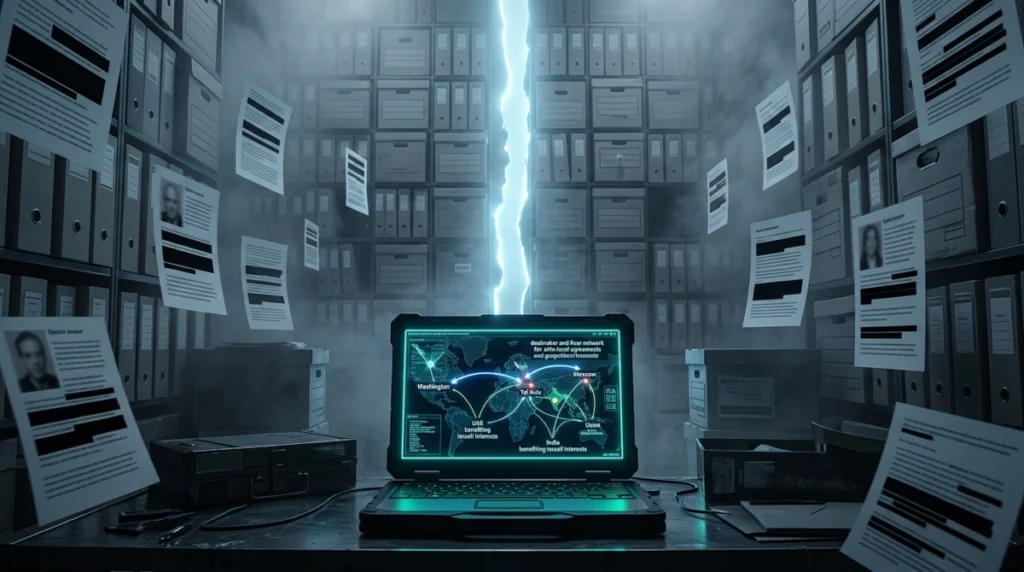
“Epstein [acted] as a ‘dealmaker and fixer’ for elite-level agreements and geopolitical interests… including backchannels to Russia, the UAE, and India… benefiting Israeli interests.”
From facilitating a 2013 backchannel between Barak and Vladimir Putin regarding Syrian policy to brokering cybersecurity deals involving Unit 8200-linked firms, Epstein’s utility to the Israeli elite appears far more structural than previously admitted.
The Silence of the Investigators: A Pattern of “Willful Negligence”
A central theme emerging from the 2026 archive is the repeated failure of authorities to act on credible leads—a pattern that transcends “bureaucratic incompetence” and enters the territory of “willful negligence.” The files reveal that even after serious allegations were made, investigators systematically failed to interview key witnesses and accusers.
The contrast in treatment is damning: while Epstein’s legal and professional teams were often “fully looped in” on developments, victims were consistently “kept in the dark.” This systemic avoidance has drawn bipartisan fire. Rep. Ro Khanna has criticised the inconsistencies, calling for the release of “all raw FBI interviews” and “prosecution memos,” while Rep. Thomas Massie has slammed the releases as non-compliant. By failing to pursue named associates found in flight logs and financial records, multiple administrations have allowed a protective shield to remain around the network’s most powerful figures.
When Quantity Becomes Quality: The Power of Circumstantial Evidence
While the DOJ maintains there is no “smoking gun” memo explicitly ordering a cover-up, the “mosaic effect” created by thousands of smaller lapses provides a persuasive picture of institutional reluctance. In investigative analysis, when a substantial body of circumstantial evidence points in one direction, it eventually serves as proof.
The 2026 files present a forest of red flags that suggest a sophisticated web of deceit:
- Inconsistent Redactions: Some victim names were left exposed, causing re-traumatisation, while the names of powerful political and business associates remain blacked out.
- Selective Visual Privacy: In thousands of images and videos, almost all faces are blurred except for Ghislaine Maxwell’s, focusing the narrative on a single, already-convicted figure.
- Hidden Metadata: PDF metadata suggests sloppy—or perhaps intentional—layers of hidden text within the digital files, hinting at a rushed or manual redaction process.
- Missing Prosecution Memos: The absence of internal memos explaining why high-profile individuals were never charged despite being named in investigative notes.
The “Russian” Misconception: Models and Diplomats, Not Dissidents
The 2026 files clarify a common misconception regarding Epstein’s “Russian connections.” The data does not point to the famous “Wild 90s” oligarchs like Mikhail Khodorkovsky, who plundered the country after the Soviet collapse and were later exiled by Putin. Those figures appear to have stayed clear of Epstein’s orbit.
Instead, the files expose an influence operation involving “Russian girls”—frequently described in emails as “trustworthy” companions—used to gain access to Western elites. Furthermore, the “Russian connection” was a diplomatic one; Epstein maintained contacts with mid-level Kremlin-adjacent officials, such as Vitaly Churkin and Sergei Belyakov, to handle sensitive backchannel information. This suggests Epstein’s network was an opportunistic tool for influence-peddling and intelligence gathering rather than a partnership with dissident billionaires.
The Transparency Paradox
The 2026 Epstein release presents a profound paradox: the very institutions responsible for the original investigative failures—the DOJ and the FBI—are the ones currently managing the “transparency” process. This is an inherent conflict of interest. When Deputy Attorney General Todd Blanche claims this 3.5-million-page dump is the “final” word, he is asking the public to trust the redactions of the same system that once struck a sweetheart deal for Epstein in 2008.
True accountability remains a ghost in the machine. As journalists navigate this labyrinth of data, the ultimate question remains: Can a system truly investigate itself? Or is this massive release merely the final layer of a decades-long effort to drown the truth in a sea of redacted noise, shielding the powerful from the consequences of their actions? The “forest of red flags” is still standing; the question is whether we have the will to look past the trees.
About The Author