This is my response to the article published by https://substack.com/@kevorkalmassian. In short, I don’t think that his (and not only his) term “Jusdeo-Christian” is accurate enough for explaining world events. I am proposing another term – “Anglo-Judeo-Evangelical” as, in my opinion, more accurate.
The Theological Foundations of the Modern Geopolitical Schism
1. Strategic Context: The Return of Civilizational Theology
In the contemporary theatre of global conflict, mainstream secular analysts remain strategically blind, dismissing religious narratives as mere cultural artifacts or secondary justifications for material interests. This is a profound intelligence failure. Rigorous assessment reveals that these narratives function as the foundational “operating system” of modern geopolitical alliances and statecraft.
To understand the current friction between the Western hegemon and Eastern sovereignty, one must recognise it as a continuation of a “Long War” whose diachronic matrix lies in the Great Schism of 1054. Traditional political science, with its focus on rational actors and market forces, fails to account for the metaphysical drivers that dictate why certain regions—the “Global East”—categorically resist integration into a centralised global order.
So What?: By ignoring the theological underpinnings of power, analysts miss the deeper tectonic shifts that define the survival of nations. This necessitates a brutal deconstruction of the ideological masks currently used to mobilise Western power, beginning with the persistent myth of a unified Western religious identity.
2. Deconstructing the “Judeo-Christian” Construct
The term “Judeo-Christian” is not a theological bridge; it is a strategic tool for imperial mobilisation and the alignment of Transatlantic interests. This construct deliberately obscures a profound civilizational divergence between historical Middle Eastern Christianity and the modern Western phenomenon of Christian Zionism.
- The Aleppo Perspective: Rooted in the Armenian Orthodox and broader Eastern traditions, this worldview views faith as entirely distinct from the territorial ambitions of modern political entities. It recognises no religious obligation to unconditionally support a modern state, viewing such mandates as a betrayal of justice and mercy.
- Western Christian Zionism: A radical departure from historical Christianity, this “political cult” interprets scripture as a mandate for absolute military and diplomatic support for a specific nation-state, often ignoring the systematic destruction of traditional Christian communities in the same region.
Mythology vs. International Law
| Mythology (Religious Justification) | Legal and Humanitarian Casualties |
|---|---|
| Selective scripture used to claim rivers, borders, and specific territories. | Replacement of Legal Title with Myth: The total erosion of the Westphalian system and international recognition. |
| Elevation of religious myth as a surrogate for legal standing and force. | Theatrical International Order: The reduction of international law to a facade, where raw force becomes the supreme interpreter. |
| Territorial expansion was framed as a “divine mandate” or transcendental duty. | Civilizational Chaos: The normalization of extra-legal expansion and the systematic undermining of sovereign rights. |
So What?: When selective scripture is elevated above international law, the global legal order is reduced to a theatre of the absurd. This shift allows imperial logic to bypass rational or ethical critique, moving state actions into the realm of “blind spiritual devotion,” where the mythic claim replaces the legal deed.
3. Anatomy of the Anglo-Judeo-Evangelical Axis
To accurately map modern power structures, we must discard the generic “West” label in favour of the more precise “Anglo-Judeo-Evangelical” axis. This terminology captures the specific coalition of interests currently driving transatlantic policy toward the Global East.
- The Anglo Pillar: This component inherits the imperial logic of the British Empire, now manifested as Washington’s “rules-based order.” It utilises a moralising mask of “universal values” to maintain strategic control over key global nodes, framing expansion as a defence of civilisation itself.
- The Judeo Pillar: This refers to political Zionism as reflected in specific ruling structures, such as the Trump-Netanyahu alignment. Here, religious and historical myths are deployed as a surrogate for force, providing a transcendental justification for state actions that would otherwise be indefensible under international law.
- The Evangelical Pillar: This is driven by a “Dispensationalist” theology—a modern American cult mechanism. By convincing millions that supporting a foreign military power is a prerequisite for spiritual salvation, it transforms religious devotion into a reflexive, uncritical support for military interventionism.
So What?: This triad immunises imperial policy from rational critique. By moving strategic objectives into the sphere of spiritual necessity, the axis ensures that its pursuit of hegemony is viewed by its domestic population not as a political choice, but as a divine command. This leads directly back to the historical root of this divergence: the Great Schism.
4. The 1054 Matrix: Secularised Papism vs. Autocephaly
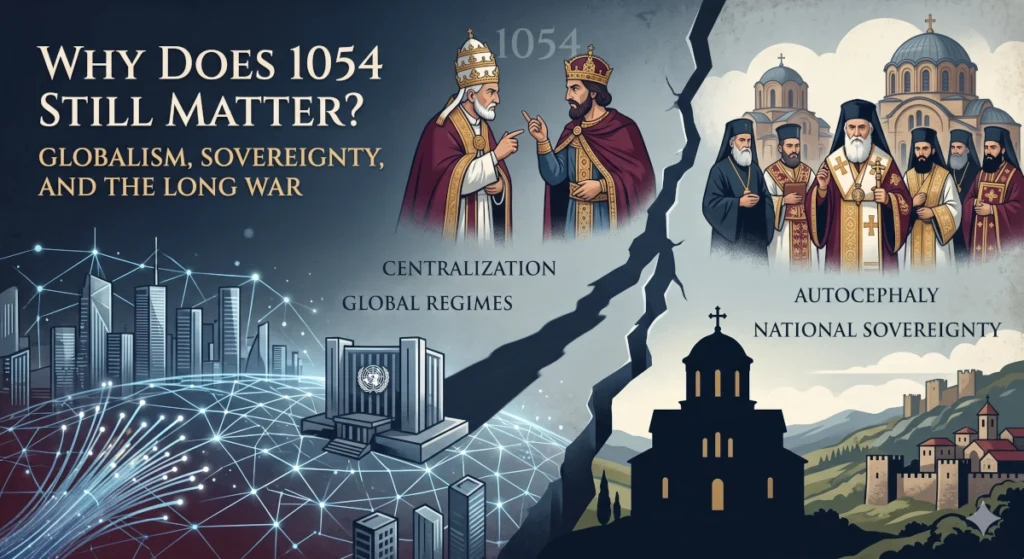
The Great Schism of 1054 remains the active tectonic fault line beneath contemporary globalist and sovereignist movements. This historical rupture created two diametrically opposed models of power that define the current global schism.
- Western Vertical Universalism (Secularized Papism): This model is built on the concept of a central, “infallible” authority—once the Pope, now the technocratic globalist center—that dictates rules to the periphery. Modern globalism is the secular successor to this model; it utilises supranational institutions to enforce ideological and economic obedience, treating national sovereignty as a “heresy” to be suppressed.
- Eastern Autocephaly: Rooted in the Orthodox model of a “community of equals,” this concept served as the theological precursor to the modern sovereign state. It legitimises a nation’s right to its own identity, language, and independent agency, viewing the world as a collection of independent centres rather than a single vertical hierarchy.
So What?
- The Role of the State: In the Eastern model, the state is the protector of the community and its “Asabiyyah” (social cohesion).
- Obstacles to Capital: In the Western model, sovereignty is viewed as an inefficient obstacle to the free flow of capital and centralised management.
- Metaphysical Conflict: The struggle between globalist universalism and national sovereignty is a modern manifestation of this thousand-year-old structural divide, where the “Rules-Based Order” is simply the latest iteration of Papal infallibility.
5. Mechanics of Hegemony: The Tactics of Civilizational Erosion
Where military force is insufficient to breach sovereign defences in the “Global East” (the Balkans, Middle East, and Slavic regions), imperial pressure manifests through sophisticated methods of annexation designed to dissolve the target from within.
- Economic Engineering: The systematic transformation of sovereign states into “raw material bases.” For these regions, resource sovereignty (land, water, minerals) is not a policy—it is a metaphysical duty to the continuity of the people.
- State Capture by “Euro-Satanist” Elites: The imposition of compromised or “Euro-Satanist” elites who have abdicated their sovereignty. These elites are viewed by the East as metaphysically compromised because they prioritise external centres of power over the historical and spiritual continuity of their own nations.
- Cultural Disintegration: A military-grade tactic targeting Asabiyyah (social cohesion). By eroding historical continuity and social bonds, imperial forces ensure a population is unable to mount organised resistance, rendering them passive participants in their own exploitation.
So What? These tactics target the “invisible matrix” of a nation. When a nation’s dignity and will to persist are eroded by cultural and economic forces, the state becomes a hollow shell, serving external machinery at the expense of its own survival.
6. Strategic Outlook: Sovereignty in the Age of Global Schism
For foreign policy analysts, the re-incorporation of “diachronic depth” is a strategic imperative. We must view the map not just through current borders, but through the thousand-year-old theological operating systems that drive human resistance and alignment.
Core Strategic Imperatives:
- Map the 1054 Fault Line: Predict future flashpoints—particularly in the Balkans and Eastern Europe—by identifying where “Vertical Universalism” attempts to overwrite “Autocephalous” sovereign structures.
- Identify the “Rules-Based Order” as a Tool of Hegemony: Recognise when “universal” rules are being deployed as secularised religious authority to bypass the legal sovereignty of independent states.
- Recognise Resource Protection as a Metaphysical Duty: Understand that, for the Global East, the defence of rivers, soil, and minerals is a struggle for civilizational survival, not just for economic advantage.
So What? The struggle for national dignity today is a direct continuation of the 1054 civilizational divide. Modern sovereignty is the political descendant of autocephaly. In an era of globalist universalism, the model of the autocephalous, sovereign state remains the only effective shield against the erasure of local identity and the centralised control of the global periphery.
About The Author