How two leaders with opposite origin stories built the same machine for bypassing the law
Aleksandar Vučić began his political life as a young man shouting about a Greater Serbia. Edi Rama began his career as a painter, fleeing to Paris rather than serving a regime he despised. One is remembered for war-era nationalism, the other for repainting Tirana’s grey communist façades in candy colours. On the surface, nothing connects them.
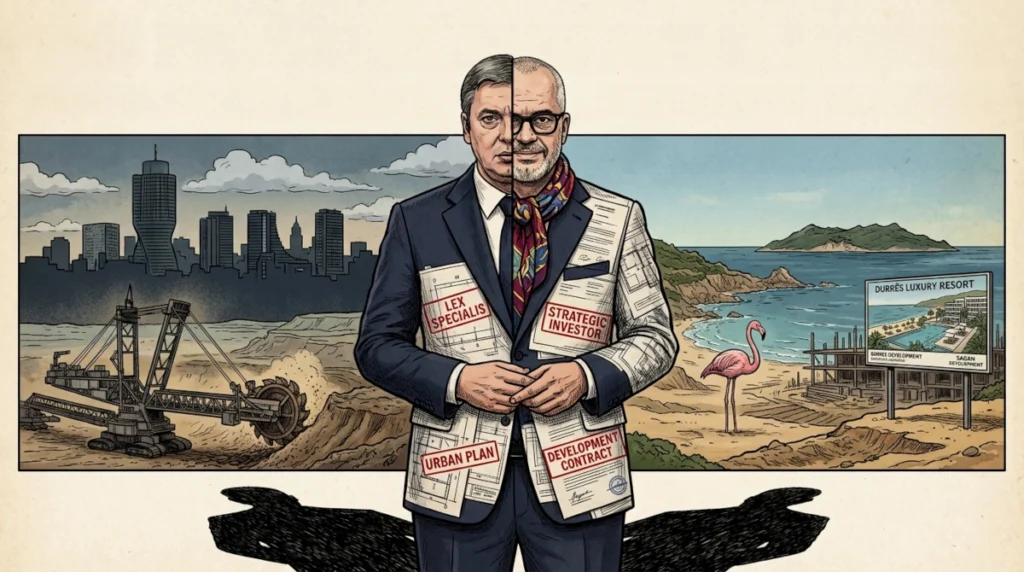
Look instead at how each man’s government actually moves a billion-euro project from announcement to bulldozer, and the resemblance becomes hard to ignore. Belgrade and Tirana have each built a legal shortcut that does the same job: when a project is big enough and connected enough, the ordinary rules — tenders, environmental review, local planning, public objection — simply stop applying. In Serbia, it is called lex specialis, a special law passed for a single project. In Albania, it is a “strategic investor” status, granted at the discretion of a government committee. Different names, same effect: the law steps aside, and the deal goes through.
Serbia: special laws, special treatment
The model has a clear point of origin: Belgrade Waterfront, the riverside redevelopment unveiled in 2014. A dedicated law lifted the project above the city’s own urban plans and ordinary procurement rules, turning what would normally be a contested municipal planning process into a fait accompli.
The same logic later attached itself to the Jadar lithium project, Rio Tinto’s plan to build what could become Europe’s largest lithium mine in western Serbia. The government revoked Rio Tinto’s licence in 2022 after mass protests, then reversed course: in 2024, the Constitutional Court ruled that revocation unconstitutional, the licence was reinstated, and the European Commission moved to grant Jadar “strategic project” status under the EU’s Critical Raw Materials framework — a designation that, like Serbia’s own special laws, is meant to fast-track permitting. Protests against the mine have continued ever since, including road blockades and arrests of activists. By late 2025, Rio Tinto itself signalled it was scaling back investment in the project, citing the continued lack of regulatory progress.
The wider backdrop matters too. Since the collapse of a railway station canopy in Novi Sad in November 2024, which killed sixteen people and was widely blamed on corner-cutting in a state-contracted renovation, Serbia has lived through more than a year of sustained, student-led protests over corruption, the capture of institutions, and the erosion of independent oversight — the same complaints that critics of lex specialis have made about mining and construction deals for a decade.
Albania: the “strategic investor” as a master key
Albania’s Law on Strategic Investments does, formally, what Serbian special laws do case by case: a government committee, chaired by the prime minister, can designate a private project “strategic,” unlocking expedited permits, access to state land and reclassified protected land, and exemption from standard competitive tendering.
The clearest recent example is the Sazan Island and Vjosa-Narta resort, a roughly €1.4–4.7 billion luxury tourism development linked to Jared Kushner’s investment fund, Affinity Partners, through a vehicle called Atlantic Incubation Partners. Albania’s Strategic Investment Committee granted the project strategic-investor status at the end of December 2024, days before Donald Trump’s second inauguration. Legislative amendments that same year reclassified part of a protected coastal wetland — habitat for one of the Mediterranean’s few flamingo breeding colonies — to permit construction. Land changed hands without open tender.
When heavy machinery and barbed-wire fencing appeared on the protected dunes in May 2026, the backlash was immediate and large: weeks of nightly protests in Tirana, now known as the “Flamingo Revolution,” with crowds demanding the project’s cancellation, the return of disputed land to its former owners, and, in many cases, Rama’s resignation. Albania’s anti-corruption prosecution service, SPAK, opened an investigation in June 2026 into how the underlying land titles were acquired and froze the accounts of the company that sold them to the developers. It was not the government’s first brush with this kind of scandal — earlier strategic-status and procurement controversies, including the jailing of a former environment minister over waste-incinerator contracts and a sitting deputy prime minister indicted over tender manipulation, follow a similar shape: a discretionary designation, a politically connected beneficiary, and a process that never goes to open competition.
The common point: lawlessness with a permit slip
Strip away the local detail, and the two systems do the same three things.
They kill competition. Once a project is “special” or “strategic,” there is no tender, no rival bid, no public comparison of offers — only a negotiated, closed-door arrangement between the state and a chosen partner.
They turn the state into the project’s bodyguard rather than the law’s. Once a development carries this status, objecting to it stops being a planning dispute and starts being framed as opposition to the “national interest” itself, which is part of why both governments have responded to protests with police presence, legal pressure on activists, or attempts to insulate officials under investigation from judicial oversight.
The damage, when it happens, doesn’t reverse. A protected wetland that’s been bulldozed, a river valley converted to mine tailings, or a public waterfront privatised cannot simply be restored once the special law has done its work.
The convergence
Vučić spent the 1990s constructing a nationalist myth and the 2000s learning to dismantle it for a more electable, centrist image. Rama spent the same decades doing the reverse: building the myth of the cosmopolitan artist-mayor who would modernise his country through design and colour. Both are, in their own way, skilled at political theatre — they just chose opposite costumes.
What they share now is less ideology than an operating system: control over courts and media sufficient to manage scrutiny, patronage networks that outlast any single ministry, and — at the centre of both — a legal mechanism that lets the executive override ordinary process whenever the project is large enough to matter. Each is currently facing the largest protest movement of his tenure, and in both cases the trigger was not abstract politics but a concrete, physical project: a collapsed canopy in Novi Sad, bulldozers on a protected beach near Vlorë.
About The Author