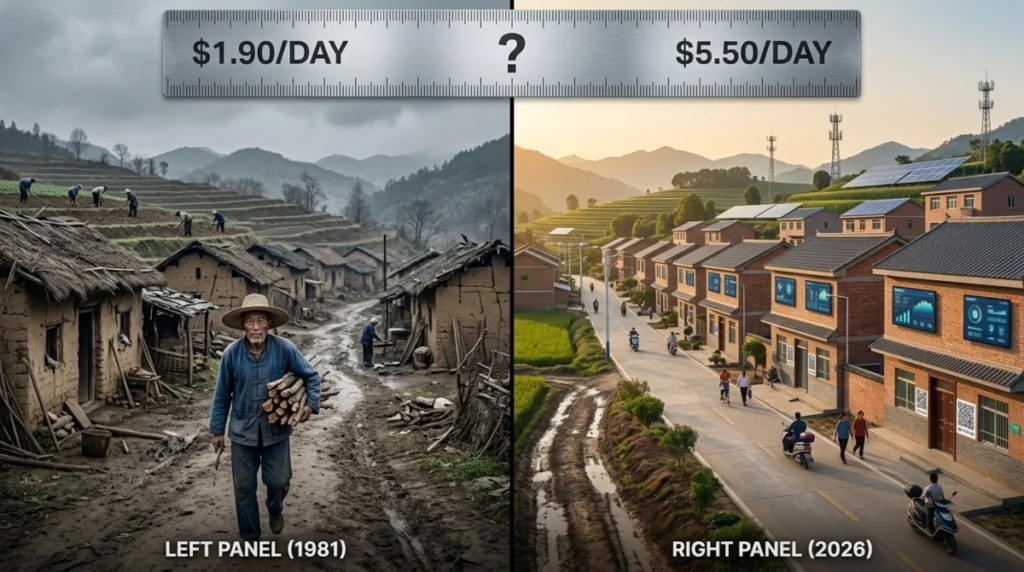
China’s War on Poverty, Five Years On: What the 2021 Story Left Out? When I first wrote about China’s declared victory over absolute poverty, the headline numbers did the talking: 700 million people lifted out of destitution in four decades, a poverty rate that fell from 88 per cent in 1981 to under 1 per cent by the mid-2010s, and a Western press corps that mostly looked the other way.
Five years on, with the dust settled and the transition period that followed the 2020 announcement now closing out, it’s worth asking a harder question than “did China do this?” The evidence says yes. The harder question is: by what yardstick, and what happens next?
The number was real — but the ruler is contested
The core statistic in the original piece — poverty falling from 88 per cent to 0.7 per cent, measured against the World Bank’s $1.90-a-day line — is accurate and still cited today. What the piece didn’t say is that this line was calibrated for the world’s poorest countries, and that the World Bank’s own research suggests a country at China’s income level should be measured against a much higher bar — something closer to $5.50 a day. Applied at that threshold, China’s poverty rate looks meaningfully less dramatic than the headline implies, and by one estimate, a US-style poverty line from the 1960s would classify the large majority of China’s population as poor today.
None of this erases the achievement. But there’s a case worth engaging seriously, made most sharply in a 2023 Cambridge Journal of Economics paper: using OECD subsistence-basket data rather than the World Bank’s PPP methodology, extreme poverty in China during the socialist-planning years of the 1980s already sat far below comparable developing economies of the period — well under the rates in India, Indonesia, or Brazil at the time. If that’s right, the standard narrative that credits market reform alone for the “miracle” is doing more work than the evidence supports. The real story may be less a single before-and-after photograph and more a longer, messier line — one where planning-era provisioning, reform-era growth, and post-2013 targeted intervention all contributed something.
Beijing didn’t declare victory and walk away
The more interesting story since 2021 is what China did after the announcement, and this is where the original piece stopped short simply because the events hadn’t happened yet.
Rather than dismantling the poverty-alleviation machinery built over the preceding decade, Beijing repurposed it. A five-year “transition period” (2021–2025) kept the cadre networks, household databases, and targeted-assistance programs running, aimed now at catching people at risk of falling back into poverty rather than lifting them out for the first time. The mechanics are genuinely novel: provincial governments run dynamic, annually adjusted income thresholds rather than a single fixed poverty line — Hunan’s relapse-risk threshold rose from ¥6,500 in 2021 to ¥8,700 in 2025, tracking local inflation and income growth. In Guizhou, a big-data platform cross-references health, education, housing, and welfare records to flag early warning signs — a spike in medical bills, a child dropping out of school, storm damage to a home — and routes alerts to local officials for verification.
The scale is not trivial. Agriculture ministry figures put the number of people identified and assisted through this monitoring system at over 7 million since 2021, with reported stabilisation rates in individual provinces running above 70 per cent. Cumulative infrastructure investment in formerly poor areas is put at roughly ¥850 billion (around $124 billion).
The newly released 15th Five-Year Plan (2026–2030) folds this permanently into rural policy rather than treating poverty elimination as a finished project — officials have been explicit that illness, disability, and natural disaster will keep pushing rural households toward the edge, and that the “safety net… must be as solid as a fortress,” as Xi Jinping put it during a March 2025 inspection tour. Independent health-economics research backs up the underlying concern: a 2025 study of rural Jiangxi households found roughly one in five previously-poor households still vulnerable to poverty driven specifically by health shocks and labour loss — a reminder that income thresholds alone don’t capture the fragility underneath them.
Whether this constitutes a genuine, durable floor under rural incomes, or an indefinitely-extended state monitoring apparatus dressed in welfare language, is a legitimate question — and one a policy-literate readership can weigh for itself once the mechanism is described plainly rather than through either propaganda or dismissal.
George W. Bush and Trump would make pompous presentations, declare victory and forget about it all as soon as marketing benefits become smaller.
The geopolitical backdrop has moved a long way past 2021
The original piece paired the poverty story with a section on Biden’s February 2021 executive order on chip and rare-earth supply chains. That episode now reads like the opening skirmish rather than the war. Since then:
- China imposed successively tighter rare-earth export controls through 2025, at one point applying a foreign-direct-product-rule mechanism — a legal tool the US pioneered against Chinese chipmakers — back against American and allied supply chains, covering products with even trace amounts of Chinese-sourced material.
- Trump threatened a 100 per cent tariff on Chinese goods in October 2025 in response, before a truce was negotiated in November 2025 that rolled back rare-earth curbs in exchange for eased US tech restrictions and Chinese soybean purchase commitments.
- A May 2026 Trump-Xi summit in Beijing left the core chip-export dispute unresolved, even as Washington quietly cleared Nvidia H200 sales to major Chinese firms.
- On the US side, the response has shifted from executive-order reviews to direct industrial buildout: several billion dollars committed since mid-2026 to rare-earth and magnet supply chains outside China, a new critical-minerals stockpiling program (“Project Vault”), Pentagon land opened to minerals processors, and expanded allied coordination.
The throughline from 2021 to now isn’t that Washington “lost interest” — it escalated from supply-chain reviews to direct confrontation and industrial policy, while Beijing discovered its own rare-earth dominance was a usable lever rather than just a talking point. That’s a more consequential shift than anything in the original EO, and arguably the real sequel to the story the piece was telling.
What an update should say
Five years out, the more defensible version of this story isn’t “China won, the West won’t admit it” — it’s a more layered claim: China’s poverty numbers are real by the metric used, contestable by others, and the country’s post-2020 policy shows it doesn’t fully trust its own victory declaration, hence the permanent monitoring apparatus that followed. Meanwhile, the US-China standoff that the original piece treated as a footnote has become one of the defining fronts of the relationship. Both threads are worth their own follow-up — separately, rather than stitched together as they were in the 2021 version.
Anthropic’s Claude AI was the major contributor to writing this article. Importantly, we did not burn any books in that process.
About The Author




1 thought on “China’s War on Poverty, Five Years On”