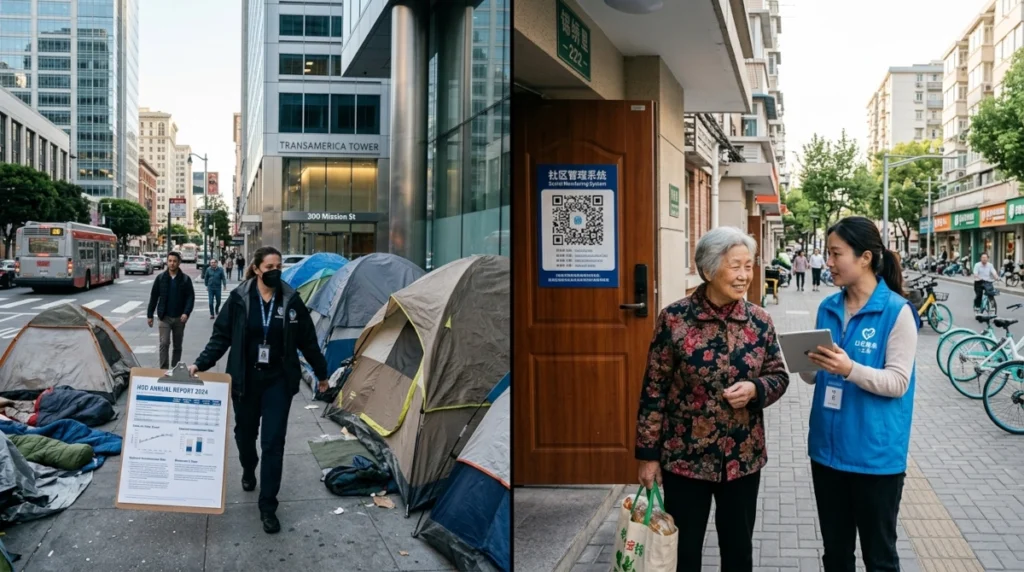
This is a continuation of my article about how China tackles poverty. Homelessness is one of the crucial standards for measuring poverty in any society, be it a “dictatorship” or a “democracy”
Statistics or Well-Being? What Homelessness in America Says About Two Systems
Five years ago I wrote about China declaring victory over absolute poverty. Yesterday I attempted to update relevant information and put it in current perspective. The reaction to my first article from most Western readers wasn’t to question the number — it was to change the subject.
Fair enough: China’s poverty data comes from a one-party state (“dictatorship”) with every incentive to look good on paper, and scepticism is a healthy default, particularly if it is coming from a “democracy”. But scepticism has to run in both directions, and the country that spent those same five years lecturing the world about transparency and accountability has a number of its own worth sitting with. It seems that “democratic” countries tend to turn to ideological labelling whenever asked unpleasant questions.
The numbers
Homelessness in the United States hit a HUD-counted 771,480 people in January 2024, the highest figure recorded since the federal government began tracking it in 2007. That’s roughly 28 per cent higher than the count in January 2020 — a rise that comfortably outpaced US population growth over the same stretch, which moved by only about 2% annually. Put simply: America didn’t just have more people between 2020 and 2024; it had proportionally far more people with nowhere to live. In my mind, it signals that America is not successful in its own war on poverty.
There was a modest correction in the January 2025 count — down about 3 per cent, the first annual decline since 2016 — and it would be dishonest to leave that out. But “modest decline from a record high” is not a recovery story. Homelessness remains close to the worst levels ever measured in the country, chronic homelessness continues to climb, and the number of homeless children rose 33 per cent in a single year between the 2023 and 2024 counts — the sharpest increase of any age group. This is happening in the world’s largest economy, a country whose per-capita GDP dwarfs China’s by a wide margin.
How do I read these numbers?
Here is the part that should trouble Americans more than it seems to: this isn’t a crisis that snuck up on policymakers. Rising rents, the expiration of pandemic-era housing assistance, and the sunsetting of programs like Emergency Housing Vouchers were all foreseeable, tracked in real time, and published annually by HUD in granular, public detail. The United States has, by a wide margin, the most transparent homelessness data of any major economy. It knows exactly how bad the problem is, block by block, year by year — and the number kept climbing anyway for the better part of a decade.
That is the contrast worth drawing with China, and it isn’t simply “China’s numbers are opaque, America’s are open” — it’s what each government does once it has the number in hand. Beijing’s post-2020 anti-poverty machinery, whatever one makes of its authoritarian bones, was explicitly built to keep a floor under people, tracking over 7 million individuals identified as at risk of falling back into poverty since 2021 and intervening — medical bills, school dropouts, damaged housing — before the fall happens. Washington has arguably the better instrument panel and the weaker response. It counts its poor more precisely than almost anyone on Earth and has, over the past several years, let the number rise anyway. Does Washington really care?
Individualism, collectivism, and the excuse in between
This is where the disagreement is really ideological, and I’d rather say so plainly than pretend it isn’t. American political culture, at a deep level, treats poverty and homelessness as substantially a matter of individual circumstance and individual responsibility — a position with a long lineage in US social policy debates, and one with genuine intellectual defenders who argue that state-directed welfare corrodes self-reliance and distorts labour markets. China’s system, for all its coercive machinery and its apparently very real human costs elsewhere, starts from a collectivist premise: the state is answerable for outcomes at the bottom of the income ladder, full stop. And it builds bureaucratic apparatus accordingly.
I don’t think this is only a rhetorical difference. A government that treats homelessness as primarily a personal failing will build a homelessness count. A government that treats it as a state failure will build a homelessness intervention. The US has built an extraordinary version of the former and, comparatively, a thin version of the latter — federal rental assistance reaches a minority of eligible households, and the metrics are published faithfully while the underlying trend is allowed to worsen year after year.
In its broadest definition, democracy is a society where people freely elect their leaders to lead society in the best interests of those people. Homeless people included. On the other side, by popular Western belief, dictatorship is a society in which a group of people illegally and often brutally controls the rest of the population. By further “definition”, dictatorships don’t care about their people. I know this is taking me into ideological waters, but I felt it needed to be said loudly.
The obvious rebuttal, and why I’d still make the case
The fair counterargument deserves space here rather than a dismissal. China’s own relapse-monitoring system is itself a statistics-driven apparatus — dynamic income thresholds, algorithmic red-flagging of vulnerable households — dressed in the language of care rather than counting. Critics would say Beijing has simply built better-marketed statistics, not a fundamentally different orientation, and that the closed nature of Chinese governance makes independent verification of stabilisation claims far harder than checking HUD’s public point-in-time data. That’s a legitimate objection, and I can’t fully rebut it with the sourcing available to outside observers — China’s numbers should be read with real caution, as I noted five years ago.
After all, take a walk around any Chinese city and do the same in any US city. You will find it very difficult to find any homeless people on the streets of Chinese cities. On the other hand, homeless people are frequent on the streets in the US. After that walk, you will not be able to compile any “scientific” numbers of homeless people, but I am sure you will get a very clear picture.
But the honest response to “we can’t fully verify China’s numbers” is not “therefore assume our own system, verified in exhaustive public detail, is working.” The US knows precisely how many people it has failed to house, publishes the number every year with more granularity than almost any government on Earth, and the number has been getting worse. That is not a data problem. It’s a choice about what the data is for.
Anthropic’s Claude AI was the major contributor to writing this article. Importantly, we did not burn any books in that process.
About The Author