Author: https: Marko Tanaskovic
Did Pier Paolo Pasolini announce Epostein? Creepy stories about the rape and torture of children, the eating of babies and the drinking of blood, the cruel and occult rituals of the most powerful and respected individuals, from the very top of the social ladder, have long been part of the mythology of so-called conspiracy theorists and obscure characters from the margins, but now they have become a harsh and documented reality that will be painful, long and difficult to deal with.
There is no doubt that the latest in a series of releases of the so-called Epstein files has led to the most devastating political upheaval in the history of modern life in the West. Even in their heavily censored, redacted form, these “documents from hell” undoubtedly confirm that virtually the entire social elite (political, financial, scientific, media and cultural) is irretrievably mired in pedophilia, sexual violence, cannibalism and Satanism.
Compared to this knowledge, affairs and scandals such as the Kennedy assassination, September 11, and Watergate seem like nothing more than a mild cold. It can also be said that the intelligence background to the entire scandal (who Epstein worked for and for what purpose) completely fades into the background, because it becomes far less important what this compromising information was used for, than the bare fact of what monstrous things those people who occupy leading positions in the hierarchy of Western societies were ready to do, from members of royal families to political leaders and famous scientists to the most respected and wealthy businessmen.
Creepy stories about the rape and torture of children, the eating of babies and the drinking of blood, the cruel and occult rituals of the most powerful and respected individuals, from the very top of the social ladder, have long been part of the mythology of so-called conspiracy theorists and obscure characters from the margins, but now they have become a harsh and documented reality that will be painful, long and difficult to deal with.
All those very beautiful and soothing phrases and platitudes about democracy, the rule of law, civil society, transparency and the liberal civilization of progress, which we, like fascinated serfs, have obediently listened to since the end of World War II, melt and disappear before the revealed, unpleasant truth that for a very long time now, practically the entire planet has been ruled by a well-connected and networked handful of vampires and depraved demons in human form. Now all the masks have fallen, all the illusions have been shattered, and the grinning face of the Antichrist is revealed to us all, like smoke billowing from the burned remains of the biblical Sodom and Gomorrah.
In an attempt to find an explanation for the current situation and the warning signs along the way, many have resorted to the subliminal and metaphorical language of art. Kubrick’s film “Eyes Wide Shut ” and the conspiracy theories that accompany it are often cited as an insider’s foreshadowing of Epstein and his diabolical activities in high society. However, it seems that another film far better predicted and explained the sodomite debauchery and depravity of Epstein’s island and its visitors.
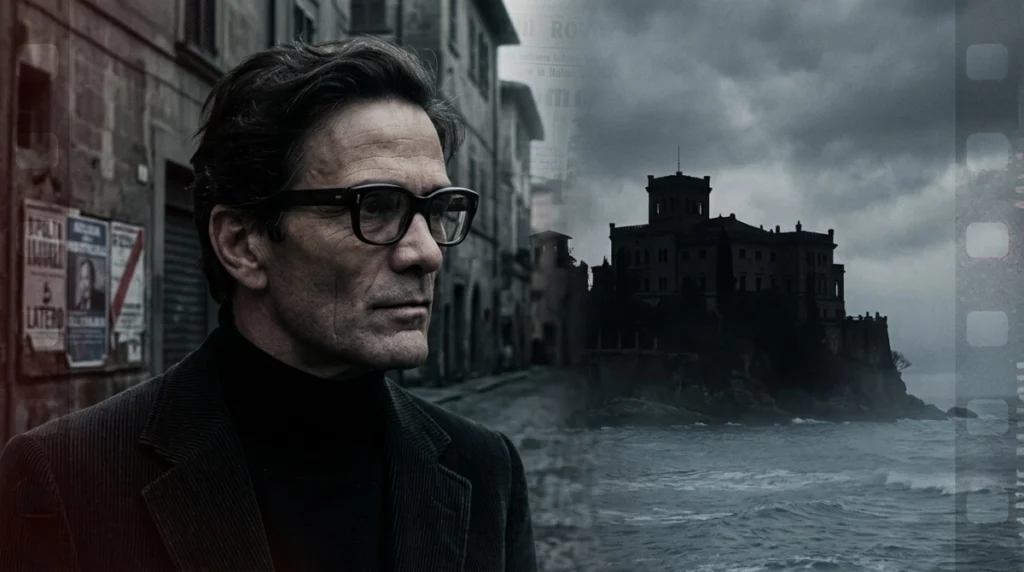
It is a half-century-old Italian film by Pier Paolo Pasolini. Pasolini’s “Salò” is one of the most explicit and extreme cinematic works, which is extremely difficult and painful to watch. However, despite the film’s shocking and bizarre scenes, no one denies the high artistic value and status of Pasolini’s work, which invites thought.
It is a loose adaptation of the Marquis de Sade’s novel The 120 Days of Sodom, in which de Sade details the actions of four atheist Parisian “libertines” who possess the wealth and power to carry out a plan to kidnap sixteen aristocratic young men and women from their homes and take them to an isolated castle in Switzerland, Château de Sierre; accompanied by four narrators and eight well-endowed men, the “libertines” spend four months inflicting an escalating series of sexual tortures on the young men and women, before finally slaughtering them and returning them to Paris. The young men and women to be slaughtered are chosen for their exceptional beauty, youth (between twelve and fifteen years old), and social background.
Pasolini moved the novel’s setting to 1944-45, 30 years before the film. He also moved the setting geographically, from an inaccessible mountaintop castle in Switzerland to a glittering villa on the shores of Lake Garda in the small resort town of Salou, in northern Italy.
In Salò, Italian fascist dictator Benito Mussolini established his short-lived “Republic of Salò” with his remaining supporters. Although Mussolini does not appear as a character in Paolini’s film, his desperate, extreme situation at that time is omnipresent; his “Republic of Salò” was the last bastion of fascism, ready to defend itself at all costs, with acts of ultimate atrocity, after the Italian government had surrendered to British and American forces, thereby changing sides in the final stages of World War II.
In writing the screenplay for “Salò,” Paolini made several significant changes to the characters in Sade’s novel; in particular, he placed greater emphasis on the social position of the four “libertines.” In Sade’s novel, the “libertines” are stubborn outsiders who, despite their colossal wealth, live on the disgraced periphery of eighteenth-century French society and are largely unaware of it except insofar as it can provide them with human material for their projects of sexual torture and slaughter. But the “libertines” in “Salò,” shaped by Paolini’s own version of Marxism, are conceived as symbolic “types” of representatives of the elite and are clearly fully complicit in both Mussolini’s fascist project and in Italian society in general.
One of the torturers represents the military, another the judiciary, a third the church, and a fourth the business and political elite. The young girls and boys brought to the libertine villa in Salou have all been abducted at gunpoint from peasant farms and impoverished urban areas; they are the antithesis of Sade’s handpicked cast of kidnapped aristocratic and wealthy officer children.
In his explicit depiction of the perversions, torture, and humiliation to which fascists subject children, Pasolini spares neither his young actors nor the viewer. There are harrowing and obscene scenes of homosexual and heterosexual rape, mutilation, coprophagy, and ultimately murder, accompanied by the narration of elderly prostitutes and classical music as a sign of bourgeois hypocrisy and pretentiousness. Aware that their end is near, Pasolini’s fascists indulge their most morbid urges and the anarchic sense of unlimited power that their position gives them. The end of the film, where the torturers dance merrily with the corpses of their victims, symbolises the final triumph of death over life, which for Pasolini was the ultimate goal of fascism and consumerism – the destruction of life itself and all individuality.
Pasolini’s “Salo” is an apocalyptic symbolic manifesto. Pasolini uses de Sade’s story as an allegory for contemporary society, which, in his opinion, has become fascist through conformism, consumer culture, and the destruction of the rights of historical subjects (peasants, workers). Fascism, as the ultimate expression and product of capitalism, gives those at the top a position that effectively places them above the law and gives them the feeling that they are the masters of life and death and gods on earth.
It is here that we can find the most obvious connection to Epstein. Epstein did not just offer the bodies of underage girls; he actually offered the experience of sadistic lawlessness. On his pedophile island and on his ranch in New Mexico, he was not an isolated sadist and decadent, but the manager of a legal and morally extraterritorial area where human and divine laws do not apply and where the Western capitalist elite has created for itself an experimental space, a playground for impunity.
It is difficult to predict whether there will be comprehensive investigations in the future and how many people in this world will be held accountable for their crimes, but the very fact that so much has already come to light tells us that there are still righteous people who are willing to fight against darkness and for the truth, even at the cost of their own lives.
About The Author