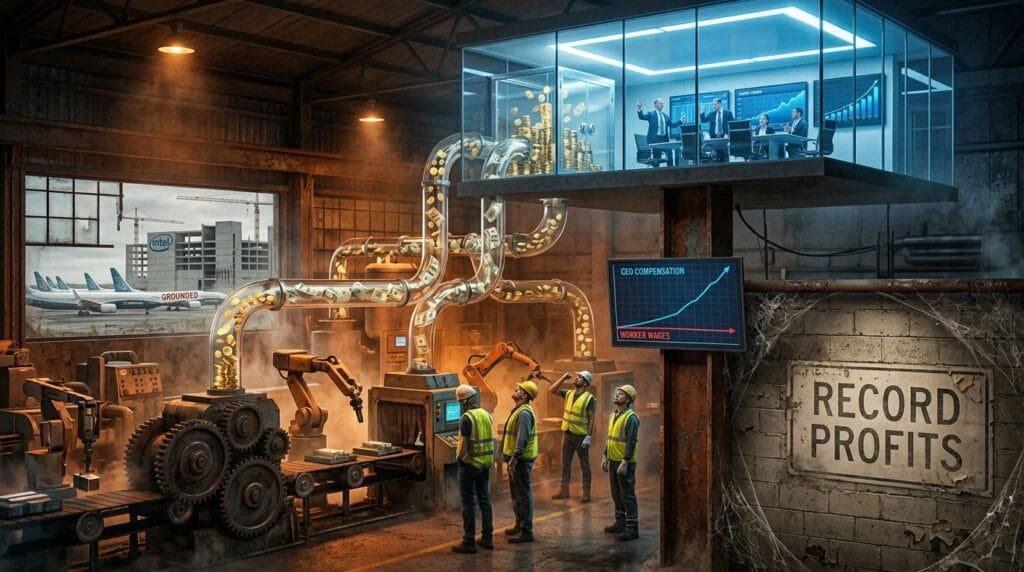
Greed and corruption are America’s second name. The diagnosis is, I think, firmly established. It is not particularly hard to analyse. Can decline caused by it be reversed?
How Financial Engineering Erodes the American Social Contract
1. Introduction: The Mirage of Post-Industrial Success
In the traditional architecture of the American Dream, prosperity was a byproduct of tangible creation—agriculture, mining, and manufacturing. This “Value Creation” model relied on cooperation and reinvestment to build a resilient social fabric. However, as the United States transitioned into a “Post-Industrial Economy,” the fundamental objective shifted. We moved from an economy that makes things to one that simply “makes money” through high-velocity financial transactions and accounting maneuvers.
This transition has birthed the era of “Fake Success.” In this paradigm, core metrics such as GDP and corporate profits can reach record highs while the underlying health of the community withers. When a corporation doubles its profit by shuttering a factory, offloading its workforce into precarious gig labour, and gutting its safety protocols, our current accounting logic records this as growth. The stock market cheers, yet the community is left hollowed out.
“An economy that is not creating new value through agriculture, mining and manufacturing is as realistic as communism.”
This “fake success” reveals a profound flaw in our socio-economic metrics: they ignore how wealth is accumulated. To understand how a nation can appear wealthy on paper while rotting at its core, we must analyse the mechanics of value extraction rather than production.
2. Makers vs. Takers: The Theory of Value Extraction
Modern economic curriculum, influenced by thinkers like Mariana Mazzucato, draws a sharp line between activities that add to the economic pie and those that merely capture a larger slice of it.
The primary driver of the “Great Hollowing” is the Financialization of the Economy. In the mid-20th century, the financial sector functioned as a “utility”—a vital support system that provided the capital industry needed to innovate. Today, however, finance has moved itself inside the “Production Boundary.” It no longer simply facilitates industry; it claims its own speculative transactions are “output” in their own right. By redefining speculation as production, the financial sector extracts wealth from the real economy to feed its own metrics.
The Economics of Value
| Feature | Value Creation (The “Makers”) | Value Extraction (The “Takers”) |
|---|---|---|
| Primary Activities | Investing in R&D, infrastructure, and worker training. | Stock buybacks, financial arbitrage, and monopoly power. |
| Primary Results | Produces a “surplus” of value and social utility. | Moves existing wealth to the top of the hierarchy. |
| Production Boundary | Viewed as the engine of actual economic growth. | Redefines speculative “churn” as economic “output.” |
| Time Horizon | Years or decades (building for future survival). | Quarters or minutes (harvesting past glory). |
This shift in the production boundary was not accidental; a single legal pivot enabled it, turning corporate treasury departments into internal hedge funds.
3. The Mechanical Trick: Anatomy of a Stock Buyback
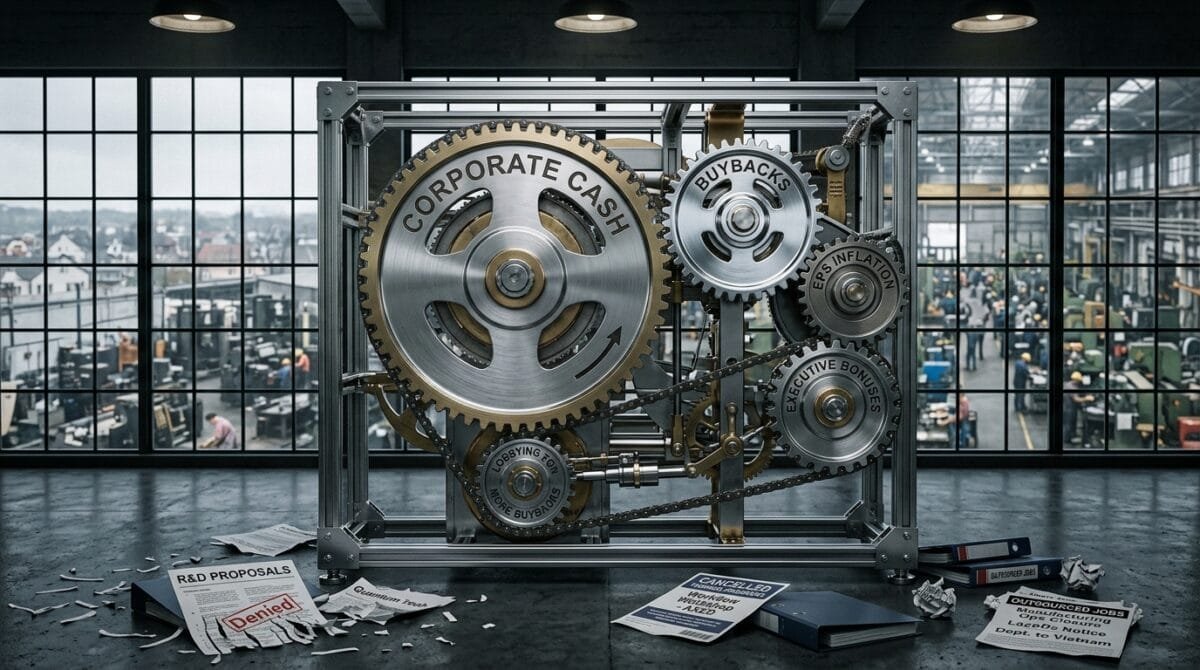
The most potent tool of value extraction is the Stock Buyback. Before 1982, the SEC viewed buybacks as market manipulation. However, the adoption of SEC Rule 10b-18 created a “safe harbour,” allowing corporations to use their own cash to manipulate their share price without fear of legal reprisal. Economists like William Lazonick identify this rule as the “engine of deindustrialisation.”
The manipulation functions through the “Buyback Loop”:
- Capital Allocation: A company uses spare cash or takes out low-interest loans.
- Share Reduction: The company buys its own shares on the open market, reducing the supply.
- Metric Inflation: This automatically increases the Earnings Per Share (EPS) and the stock price, regardless of actual company performance.
- Executive Windfall: The artificial price hike triggers massive stock-based bonuses for the CEO and board members.
“Live Money” vs. “Dead Money”
The socio-economic impact depends on how capital circulates. Live Money, generated through production, circulates through the community, paying engineers, suppliers, and local service workers. Dead Money, generated through buybacks, is “parked” in high-end real estate, art, or offshore funds, failing to support broad human participation.
The Innovation Trap
This diversion of capital has led to the technical collapse of American icons. Between 2013 and 2019, Boeing spent roughly $43 billion on buybacks, money critics argue was diverted from engineering and safety testing, leading to the 737 MAX crisis and a loss of leadership to Airbus. Similarly, Intel spent tens of billions on share repurchases while losing its manufacturing lead to foreign competitors like TSMC, proving that “financial success” can mask a terminal loss of national industrial edge.
4. The One-Two Punch: Lobbying as a Defensive Wall
This hollowing process is protected by a political defensive wall. Corporations engage in “Rent-Seeking”—the attempt to increase one’s share of wealth without creating anything new. They lobby for tax breaks and then, instead of reinvesting those savings in workers, funnel the cash directly into buybacks. This is a “virtuous cycle” for the elite and a “vicious cycle” for the public.
Lobbying vs. Buybacks by Sector (2024-2025)
| Industry | Lobbying Intensity (The “Protectors”) | Buyback Intensity (The “Extractors”) |
|---|---|---|
| Pharmaceuticals | Record $384 Million: Prevents drug price negotiations. | Extreme: Top 14 firms spent $56B more on buybacks/dividends than R&D. |
| Big Tech | Surging 33%: Influencing AI laws and antitrust regulation. | Record-Breaking: Apple authorised a single $110 billion program. |
| Finance | High: Lobbying to lower capital safety requirements. | Cyclical: Triggers “buyback sprees” as soon as regulations ease. |
| Energy | Steady: Protecting subsidies and environmental rollbacks. | High: Rewarding shareholders during high oil price cycles. |
It is a critical curriculum point to note that a buyback ban alone is not a panacea. Without broader reform, capital acts like water; it may simply shift into Dividends or Monopolistic M&A, continuing the extraction under a different name.
5. The Triple Threat: Stagnation, Wage Gaps, and Social Decay
The cumulative effect of this system is a “triple threat” that destabilises the American social contract.
- Stagnation (The Innovation Trap): Driven by “Short-Termism,” CEOs focus on 10-minute stock pumps over 10-year R&D projects. Companies stop growing “wider” (hiring/training) and only grow “taller” (inflating prices). These “Zombie Firms” effectively liquidate their future survival to pay for their present bonuses.
- The Wage Gap (The Great Decoupling): Since the 1980s, productivity has risen while worker pay has flattened. This is because the “surplus” is diverted. In major retail sectors, the money spent on buybacks in a single year could have funded a $5/hour raise for every hourly worker.
- Social Decay (The Erosion of Trust): “Footloose” corporations have abandoned their roles as anchor institutions. When a local factory is gutted for a buyback, the middle class collapses, leading to “deaths of despair”—opioid crises and rising suicide rates. This creates a justified sense that the system is “rigged,” fueling political cynicism.
The Vicious Cycle of Financialization Lobbying (Buying influence) → Buybacks (Pumping stocks) → Stagnation (No R&D/Training) → Social Decay (Stagnant wages/Loss of trust).
6. The Path to Restoration: Policy and the Pendulum
Restoring the American social contract requires a comprehensive “Policy Package” designed to shift the pendulum back toward labour and long-term production.
2025-2026 Proposals for Reform:
- The Reward Work Act: A legislative effort to ban open-market buybacks and give workers a voice in corporate governance.
- Taxation Shift: Increasing the current 1% excise tax on buybacks to 4% or higher to make financial engineering economically irrational compared to reinvestment.
- Sector-Specific Bans: Extending the COVID-era precedent—if a company receives public bailouts, tax credits, or defence contracts, they must be banned from buybacks.
- Interest Deductibility: Closing loopholes that allow companies to take on debt for the sole purpose of share repurchases.
Cracks in the Armour
Despite the power of corporate lobbying, several factors suggest the system is reaching a breaking point. Over 80% of Americans now support banning stock trading for Congress, a sentiment that is bleeding into the anti-buyback narrative. Furthermore, National Security concerns are overriding corporate interests; there is a growing realisation that if US leaders spend their cash on buybacks while foreign rivals invest in R&D, the nation loses its industrial sovereignty.
Final Summary: The “Fake Success” of a record-breaking stock market often masks a hollowed-out society. We are currently witnessing a system where wealth is extracted from a company’s past glory and at the expense of its future survival. When the metrics of success no longer require broad human participation, the economy ceases to be a tool for progress and becomes a mechanism for decay.
Learner’s Insight: The social contract is fundamentally broken when the “success” of the elite is predicated on the stagnation of the majority. Until we move the production boundary back to include only those who create real-world value, the economy will keep growing taller while the foundation of our society grows ever thinner.
Can American decline be reversed in the next several years? I don’t think so. Causes are identified, ways to rectify the situation are known and often proposed by many analysts. Is that enough? No, it is not. As someone who spent several decades in various process improvement projects, I’ve found that, more often than not, the biggest obstacle is decision-makers. The very people who hired me to “fix the problem” resisted implementation. Why? Personal interests and laziness are the shortest answer I can offer.
Is it realistic to expect that Congress, the Senate and the White House, some of the biggest beneficiaries of “lobbying” and insider trading, will vote against their personal interests? Of course not. Actually, not till they have to. What, or who, will make them vote for changes is a question I cannot answer.
Analytical heavy lifting for writing this article was performed by Gemini AI and Grok AI. Presentation was prepared by Gemini Notebook.
About The Author