Dr Alexander Dugin – The Clash of Civilisations — A Battle of Ideas
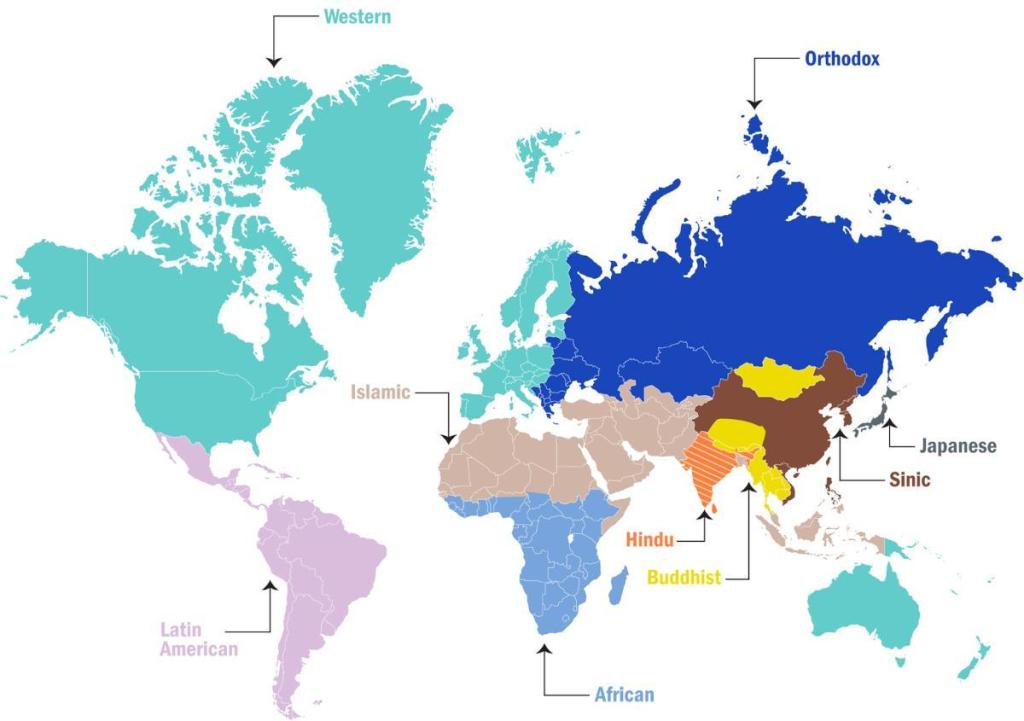
The Russian, Chinese, and Islamic ideas each have a distinctly expressed universal potential. Following them is India, while Africa and Latin America currently limit their projects within the confines of their respective continents. However, the widespread dispersion of Africans across the world has led some theorists to propose the creation — primarily in the USA and the European Union — of African autonomous self-governing zones on the principle of Brazilian quilombos.
The growing Latino-American population in the USA could also significantly influence North American civilisation and the dominant value system in the future. Due to its Catholic foundation and the preserved connection with traditional society, it will undoubtedly, sooner or later, come into conflict with liberalism, which has Protestant and distinctly Anglo-Saxon roots.
Therefore, the struggle between a unipolar world order and a multipolar one represents a clash of ideas. On one hand, there is liberalism, trying to defend its dominant positions on a global scale, and, on the other hand, several versions of illiberalism, which are becoming increasingly clearly expressed in countries that make up the multipolar bloc.
Alexander Dugin discusses the emerging multipolar world, highlighting various global regions’ distinctive ideological and civilisational pathsin opposition to the Western liberal paradigm.
Realists
Realists believe that human nature is inherently flawed (a legacy of Hobbes’ anthropological pessimism and, even more profound, echoes of Christian notions of the fall from grace — lapsus in Latin) and cannot be fundamentally corrected. Therefore, egoism, predation, and violence are ineradicable. From this, it is concluded that only a strong state can restrain and organise humans (who, according to Hobbes, are wolves to each other). The state is inevitable and carries the highest sovereignty. Moreover, the state projects the predatory and selfish nature of humans.
Hence, a national state has interests, which are its only considerations. The will to violence and greed make war always possible. Realists believe this has always been and will always be the case. International relations, therefore, are built only on the balance of power between fully sovereign entities. No long-term world order can exist; there is only chaos, which changes as some states weaken and others strengthen. In this theory, the term ‘chaos’ is not negative — it is merely a statement of the factual state of affairs resulting from the most severe approach to the concept of sovereignty.
If several truly sovereign states exist, no supranational order can be established that all would obey. If such an order existed, sovereignty would not be complete, and there would be none, and the supranational entity itself would be the only sovereign.
The school of realism is traditionally very strong in the USA, starting with its first founders: the Americans Hans Morgenthau and George Kennan, and the Englishman Edward Carr.
Liberalism in International Relations
Liberals in international relations oppose the realist school. They rely not on Hobbes with his anthropological pessimism but on Locke with his notions of the human being as a blank slate (tabula rasa) and partly on Kant with his pacifism, stemming from the morality of practical reason and its universality. Liberals in international relations believe that people can be changed through re-education and enlightenment.
This is the Enlightenment project: transforming the predatory egoist into a rational and tolerant altruist, ready to consider others and treat them with reason and tolerance. Hence, the theory of progress. If realists believe that human nature cannot be changed, liberals are convinced it can and should be. But both believe that humans are former apes. Realists accept this as an inescapable fact (man as a wolf), while liberals are confident that society can change the nature of the former beast and write anything they want on his ‘blank slate’.
But if so, then the state is needed only for enlightenment. Its functions end there, and when society becomes sufficiently liberal and civic, the state can be dissolved. Sovereignty, therefore, does not carry anything absolute — it is a temporary measure. And if the state does not aim to make its subjects liberals, then it becomes evil. Only a liberal state can exist, as ‘democracies do not fight each other’.
But these liberal states should gradually die out, giving way to a world government. Having prepared civil society, they abolish themselves. Such a gradual abolition of states is unconditional progress. In the modern European Union, we see precisely this logic. And American globalists, among whom are Biden, Obama, and the promoter of the ‘open society’ George Soros, specify that during progress, the world government will be formed based on the USA and its direct satellites — this is the project of the league of democracies.
In a technical sense, liberalism in international relations, as opposed to realism, is often called ‘idealism’. Realists in international relations believe that humanity will remain as it has always been. In contrast, liberals in international relations ‘idealistically’ believe in progress, in the possibility of changing the very nature of man. Gender theory and posthumanism belong to this ideology —they stem from liberalism.
Marxism in International Relations
Another direction in international relations worth mentioning is Marxism. Here, ‘Marxism’ is not quite what constituted the core of foreign policy in the USSR. Edward Carr, a classical realist in international relations, demonstratively showed that the USSR’s foreign policy — especially under Stalin — was built on the principles of pure realism. Stalin’s practical steps were based on the principle of full sovereignty, which he associated not so much with the national state but his ‘red Empire’ and its interests.


 Aleksandar Adzic
One response to “Dugin: A battle of Ideas & Civilisations”
[…] Battle of ideas & Civilisations […]
LikeLike